

Choosing a contractor for a home addition is one of the most consequential decisions you will make as a homeowner. The stakes are high: you are investing tens of thousands of dollars, disrupting your daily life, and trusting someone to physically alter your home. The signs reliable home addition contractor evaluation requires are not always obvious, especially when nearly every contractor claims to be licensed, experienced, and easy to work with. This article cuts through the noise and gives you a practical, detailed framework for spotting the contractors who actually deliver on those promises.
Table of Contents
- Key takeaways
- 1. Signs of a reliable home addition contractor start with a verified license
- 2. Insurance verification goes beyond asking for a certificate
- 3. A detailed written contract is non-negotiable
- 4. Clear, consistent communication throughout the project
- 5. References that actually tell you something useful
- 6. Proper permitting and inspection compliance
- 7. Red flags that tell you to walk away
- Reliability at a glance: signs vs. red flags
- My honest take after 25 years in the field
- Work with a contractor you can actually trust
- FAQ
Key takeaways
| Point | Details |
|---|---|
| Verify licensing and insurance | Confirm the contractor's license through your state board and contact the insurer directly to validate coverage. |
| Demand a written contract | A signed contract covering scope, timeline, payments, and warranties is your most important legal protection. |
| Communication signals trust | How quickly and clearly a contractor responds to your questions reveals how they will manage your project. |
| Check references with purpose | Ask specific questions about timeliness, budget, and cleanup rather than accepting generic praise. |
| Know the red flags | Upfront full payment demands, no written contract, and skipped permits are warning signs you cannot afford to ignore. |
1. Signs of a reliable home addition contractor start with a verified license
Plenty of contractors claim to be licensed. Very few homeowners actually check. The right move is to verify the license yourself through your state licensing board, not by accepting a verbal assurance or even a photocopy of a document. Contracts must be verified through the state board directly, because licenses can lapse, get suspended, or be misrepresented.

In Texas, you can check contractor credentials through the Texas Department of Licensing and Regulation. A quick search takes less than five minutes and tells you whether the license is current and whether any complaints have been filed. This single step filters out a significant portion of unreliable operators.
Pro Tip: Ask for the contractor's license number before the first meeting. If they hesitate or claim they do not need one for your project type, treat that as an immediate disqualifier.
2. Insurance verification goes beyond asking for a certificate
A contractor handing you a certificate of insurance is not the same as a contractor who is actually insured. Certificates can be outdated or issued for policies that have since lapsed. The only way to know for certain is to verify coverage directly with the issuing insurer.
Call the insurance company listed on the certificate and confirm that the policy is active, that it covers the type of work being done, and that the coverage limits are adequate. You want to see general liability insurance and workers' compensation. Without workers' comp, you could be held financially responsible if a worker is injured on your property. That is a risk no homeowner should carry.
3. A detailed written contract is non-negotiable
Verbal promises are worth nothing when a dispute arises. A well-structured written contract should cover the full project scope, a clear timeline with milestones, a payment schedule tied to completed work phases, material specifications, warranty terms, and a dispute resolution process. If a contractor resists putting any of these in writing, that is your answer about how reliable they are.
Pay particular attention to the payment schedule. Milestone payments tied to inspectable phases of work protect you far better than calendar-based payments. A retainage clause, where you hold back a percentage until final walkthrough, gives you leverage to get punch-list items resolved. The homeowner's contract guide from PRO Construction breaks down exactly what language to look for and what to push back on.
The change order clause is equally critical. Without a signed process for approving changes, verbal agreements about upgrades or modifications are nearly impossible to enforce. Signed change orders protect you from surprise costs that can balloon a budget by 20% or more.
4. Clear, consistent communication throughout the project
A contractor who is attentive before the contract is signed but disappears afterward is one of the most common frustrations homeowners report. Reliable contractors communicate proactively, not just when you chase them.
Watch how they behave from the very first meeting. Do they listen more than they talk? Do they follow up in writing after your conversations? Do they respond to messages within a reasonable window? According to Good Housekeeping's renovation experts, early rapport and comfort with your contractor strongly predict how smooth the project will be.
Here is what good communication actually looks like during an active project:
- Written summaries after key meetings or decisions
- Scheduled weekly updates on progress and upcoming work
- Prompt responses to questions, typically within 24 hours
- An open-door policy for homeowner site visits
- Documentation of any changes requested by either party
"You should feel comfortable asking your contractor questions at any point, and trust your instincts if something feels off about how they communicate." — Good Housekeeping renovation experts
Evasiveness, vague answers, or irritation at your questions are not personality quirks. They are operational warning signs.
5. References that actually tell you something useful
Every contractor can produce a list of happy clients. What separates a reliable contractor from a mediocre one is what those references reveal when you ask the right questions. Thorough reference checks are one of the most effective reliability measures available to you.
Go beyond "were you happy with the work?" and ask the following:
- Did the project finish on time, and if not, how many weeks did it run over?
- Did the final cost stay within 10% of the original estimate?
- How did the crew handle daily cleanup and respect for your property?
- Were there any issues after project completion, and how quickly did the contractor resolve them?
- Would you hire this contractor again for a project of the same scale?
If you can visit a recently completed project in person, do it. Photos are easy to curate. Seeing the quality of finishes, transitions, and structural details in person tells you far more. Matching the contractor's portfolio to your specific addition type also matters. A contractor who excels at small room additions may not have the experience for a two-story addition with a new foundation.
Pro Tip: Look at customer testimonials across multiple platforms, not just the contractor's own website. Google reviews, Houzz, and BuildZoom ratings reflect a more complete picture of how a contractor actually performs.
6. Proper permitting and inspection compliance
Skipping permits is not a shortcut. It is a liability you inherit as the homeowner. Unpermitted work can trigger fines, force you to tear out completed construction for inspection access, and create serious problems when you sell your home. Home additions typically require three to six permits with multiple inspection stages, and those permitting costs make up roughly 10 to 15% of a project budget.
A reliable contractor handles the permitting process for you, keeps you informed of inspection dates, and never suggests "going without" to save money. You can verify permit activity yourself through your local building department's online records, and you should.
Membership in professional trade associations adds another layer of credibility. Trade organization memberships require contractors to meet vetting standards and adhere to a code of conduct. It does not guarantee perfection, but it does mean someone besides you is holding them accountable. If you want a full breakdown of North Texas permitting requirements, the PRO Construction North Texas permit guide is a thorough resource.
| Permit type | Why it matters |
|---|---|
| Building permit | Confirms structural work meets local code standards |
| Electrical permit | Protects against fire and safety hazards in new wiring |
| Plumbing permit | Covers new or modified plumbing lines for code compliance |
| Mechanical permit | Required for HVAC changes or additions |
| Zoning approval | Verifies the addition meets setback and property line rules |
7. Red flags that tell you to walk away
Knowing the signs of reliability matters. Knowing what to reject matters just as much. These are the patterns that signal you are dealing with an unreliable contractor, regardless of how confident or friendly they seem:
- Demanding full payment before any work begins, or asking for more than 10 to 15% as a deposit
- Refusing to provide a written contract or offering only a one-page agreement with no detail
- Making promises verbally that never appear in the contract documents
- Being unable to verify a current, active license or presenting credentials that do not check out
- Providing only vague references or declining to share contact information for past clients
- Recommending you skip permits or suggesting they can handle it "off the books"
- Having no defined process for handling change orders or scope modifications
Any one of these alone should raise concern. Two or more and you should be interviewing a different contractor. The contract red flags that indicate unreliability are almost always visible before you sign anything, if you know where to look.
Reliability at a glance: signs vs. red flags
| Category | Reliable contractor | Red flag behavior |
|---|---|---|
| Licensing | Verifiable through state board | Claims license but cannot provide number |
| Insurance | Provides verifiable COI | Certificate is outdated or unverifiable |
| Contract | Detailed, signed, milestone-based | Vague, verbal, or single-page only |
| Communication | Prompt, written, proactive | Slow, evasive, or irritated by questions |
| References | Multiple, specific, verifiable | Vague, few, or refuses to share |
| Permitting | Manages and documents all permits | Suggests skipping or ignores requirements |
| Change orders | Written, signed before any changes | Verbal approvals or none at all |
My honest take after 25 years in the field
I have worked with homeowners across North Texas for over two decades, and I want to be direct with you about something the industry rarely admits. The biggest source of project failure is not a contractor who is outright dishonest. It is a contractor who was not vetted carefully enough at the start.
In my experience, homeowners who skip the reference check step or accept a vague contract because they liked the salesperson tend to be the ones calling us later to fix someone else's work. The uncomfortable truth is that likability and reliability are not the same thing. I have seen charming contractors produce work that failed inspection three times. And I have seen quiet, businesslike contractors who delivered flawless additions on time and under budget.
What I tell every homeowner: trust your instincts about communication, but back those instincts up with documentation. If a contractor makes you feel foolish for asking about insurance or permits, that discomfort is data. Stay engaged throughout the project, visit the site regularly, and never let important decisions happen only in conversation. Get it in writing every single time.
The homeowners who have the best outcomes are the ones who stay curious and informed from the first call to the final walkthrough. That is not micromanaging. That is protecting your investment.
— PRO
Work with a contractor you can actually trust
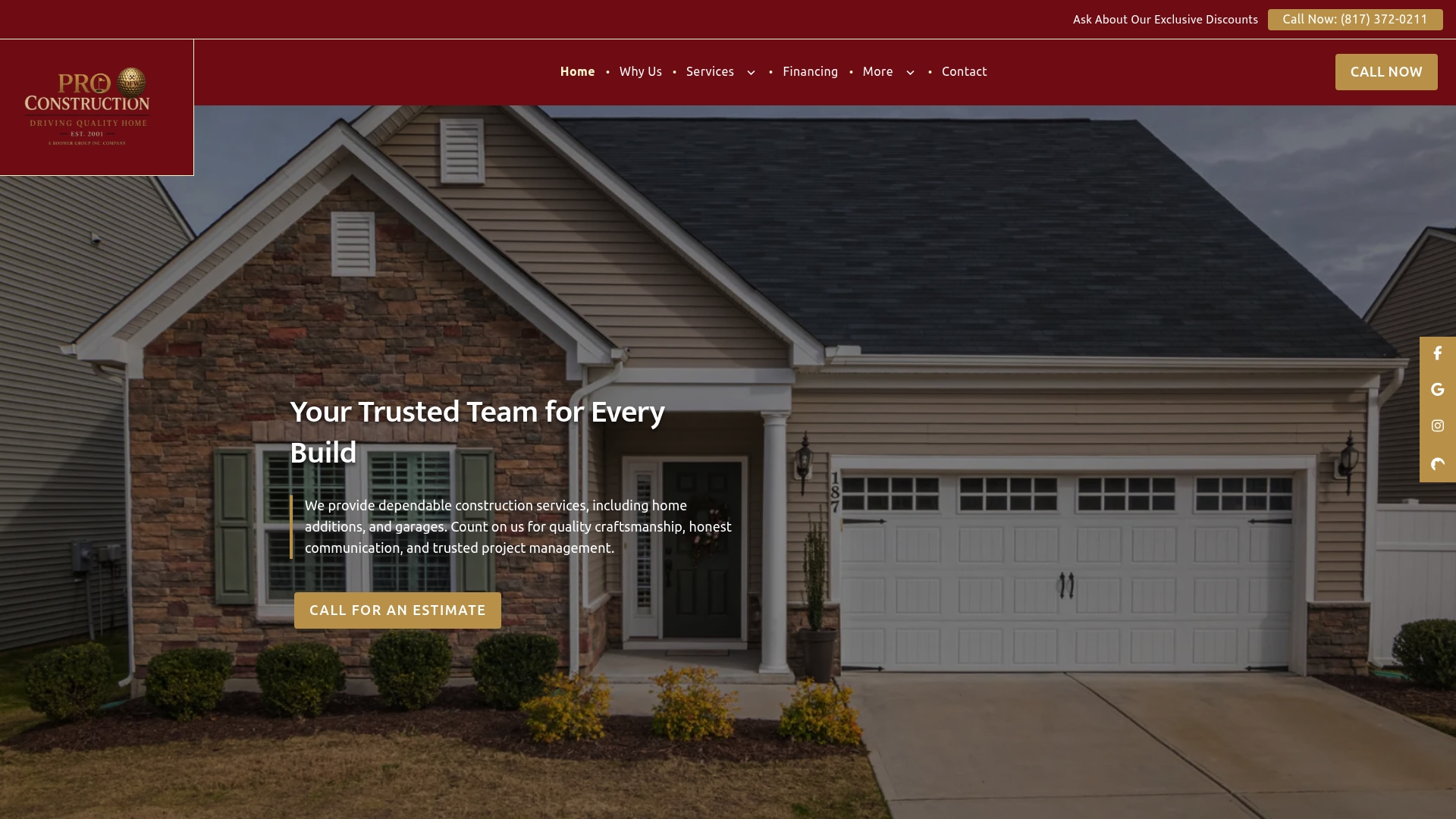
If you are planning a home addition in North Texas and want a contractor who checks every box in this article, PRO Construction is ready to talk. With over 25 years of experience, a top 1% BuildZoom ranking, and a track record of transparent communication and quality craftsmanship, PRO Construction takes the uncertainty out of hiring. Every project comes with a detailed written contract, proper permitting management, and a dedicated point of contact who keeps you informed at every stage. Explore your options on the home addition services page, or browse the 2026 buying guide to understand what questions to ask before you hire anyone.
FAQ
How do I verify a contractor's license?
Contact your state licensing board directly and search by the contractor's name or license number. Do not rely on a verbal claim or a document the contractor provides without independent verification.
What should a home addition contract include?
A solid contract covers the full scope of work, a detailed timeline, milestone-based payment schedule, material specifications, warranty terms, and a signed process for handling change orders.
How many permits does a home addition require?
Home additions typically need three to six permits covering building, electrical, plumbing, mechanical, and zoning, with multiple inspection stages throughout construction.
What are the biggest red flags when hiring a contractor?
Demanding full payment upfront, refusing to provide a written contract, and recommending you skip permits are the three most serious warning signs that a contractor is unreliable.
Why does contractor communication matter so much?
How a contractor communicates before the project starts reflects how they will manage it during construction. Prompt, written communication and a willingness to answer your questions are reliable predictors of a smoother project experience.
Recommended
- Home Addition Contractor in Keller, TX: The 2026 Homeowner’s Buying Guide - PRO Construction
- PRO Construction: Driving Quality Home - PRO Construction
- Construction Company Keller, TX | Discounts for Senior Citizens, First Responders, Teachers, & Military Personnel
- Home Addition Contractors in Fort Worth: Your Guide to Expanding Your Space in 2026 - PRO Construction