
Before you sign a contract or hand over a deposit, you need to verify contractor license Texas requirements for whoever you're about to hire. Texas has no universal general contractor license, which means the rules vary depending on the trade and where you live. That gap creates real exposure: homeowners who skip verification risk hiring unlicensed workers, losing insurance coverage, and absorbing personal liability for incomplete or dangerous work. This guide walks you through exactly how the system works, where to check, and what red flags should stop you cold.
Table of Contents
- Key takeaways
- How Texas contractor licensing actually works
- Step-by-step: how to verify contractor license status
- Red flags and common pitfalls to avoid
- How verification protects your home insurance and finances
- Additional steps for thorough contractor vetting
- My take after 25 years in Texas construction
- Work with licensed, verified professionals in North Texas
- FAQ
Key takeaways
| Point | Details |
|---|---|
| No statewide general contractor license | Texas licenses contractors by trade and city, so verification requires multiple sources. |
| Use TDLR and TSBPE for state trades | Electricians, HVAC, and plumbers are verified through dedicated state agency databases online. |
| Local offices cover other trades | General contractors and roofers require a call or portal check with your city or county permit office. |
| Verify at the moment of hiring | License status changes; always check in real time before signing, not when you found the contractor. |
| Insurance and permits matter too | A valid license means nothing if the contractor lacks insurance or refuses to pull permits themselves. |
How Texas contractor licensing actually works
Texas does not have a universal contractor license. That surprises most homeowners who assume there's one database you can search for anyone doing work on your property. In reality, licensing depends entirely on the trade type and the jurisdiction where the work happens.
Here is how the system breaks down:
- State-licensed trades include electricians, HVAC technicians, and plumbers. These professionals are licensed and regulated by state agencies regardless of which Texas city they work in.
- Locally licensed trades include general contractors, roofers, and painters. These trades are regulated at the city or county level, meaning a contractor working in Fort Worth may need different credentials than one working in Plano.
- No state GC license exists. If someone claims they hold a Texas general contractor license issued by the state, that credential does not exist. What matters for GCs is local registration and permit history.
| Trade | Licensing body | Verification resource |
|---|---|---|
| Electrician | Texas Dept. of Licensing & Regulation (TDLR) | tdlr.texas.gov |
| HVAC technician | TDLR | tdlr.texas.gov |
| Plumber | Texas State Board of Plumbing Examiners (TSBPE) | tsbpe.texas.gov |
| General contractor | City or county permit office | Local gov portal or phone |
| Roofer | City or county permit office | Local gov portal or phone |
Understanding this structure is the foundation for doing a proper Texas contractor license lookup. Each city may have its own rules requiring you to contact their permit office directly, which means there is no single shortcut that covers every situation.
Step-by-step: how to verify contractor license status
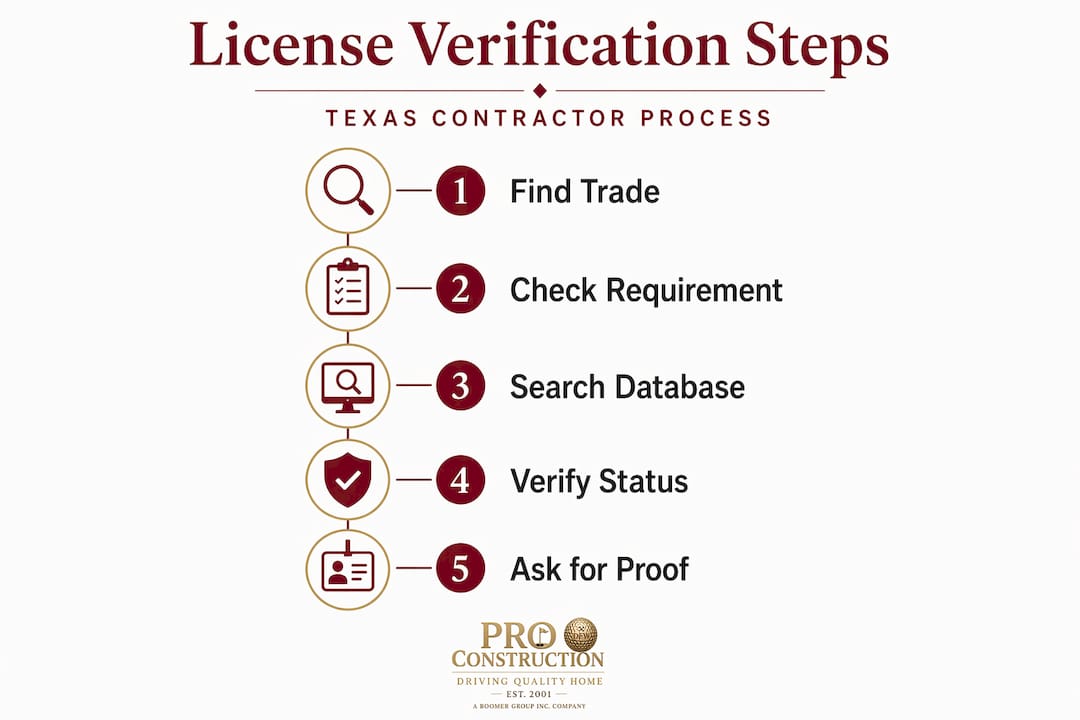
Getting this right is easier than most people expect once you know which database to use. Here is a clear sequence to follow before hiring any contractor in Texas.
-
Identify the trade. Before you search anything, confirm what type of work is being done. Electrical, plumbing, and HVAC each have separate state-run databases. Everything else points you to local authorities.
-
For electricians and HVAC: use TDLR. Go to tdlr.texas.gov and use the License Search tool. You can search by name, license number, or business name. The results show current license status, expiration date, and any disciplinary history on file. This is the official Texas license verification for contractors in those trades.
-
For plumbers: use TSBPE. The TSBPE database at tsbpe.texas.gov works similarly. Enter the contractor's name or license number to confirm their plumbing license status. The database reflects current status including suspensions or revocations.
-
For general contractors and roofers: contact your local permit office. Search for your city or county's building or development services department online. Most larger Texas cities now have online portals where you can check contractor registration and permit history. Smaller jurisdictions may require a phone call.
-
Use the SAM chatbot for fast initial inquiries. Texas launched an AI chatbot called SAM in 2026 to help the public navigate professional licensing questions. SAM can answer complex licensing questions in roughly 15 seconds and is available in both English and Spanish. It is a useful starting point, though you should still confirm status directly in the official database.
-
Search by license number when possible. Business names can be reused or slightly altered by fraudulent operators. If the contractor has given you a license number, search by that first. It is the most reliable identifier in any Texas contractor license lookup.
Pro Tip: Lead platforms may only verify once at account creation; licenses can expire or be revoked at any time. Always run your own search on the official database on the day you plan to sign a contract.
Red flags and common pitfalls to avoid
Knowing how to do a contractor license check Texas style is one thing. Knowing what can go wrong is just as important.
The most common mistake homeowners make is searching the wrong database. If you look up a plumber on TDLR instead of TSBPE, you will get no results and may incorrectly assume they are unlicensed when they are actually listed in the right place.
Watch for these warning signs before you hire:
- The contractor refuses to give you their license number or tells you it is not necessary
- They request a large cash payment upfront or insist on cash-only transactions
- They approach you door-to-door, especially after a storm or disaster
- They ask you to pull the permits yourself instead of handling it themselves
- There is no written contract, or the contract is vague about scope and payment terms
- Their business name on the quote does not match the name on their license or insurance documents
Contractors should pull permits in their own name. If someone asks you to pull your own permits, it is often a signal that they cannot pull permits under their license because it is expired, suspended, or simply nonexistent.
Common fraud signs include large upfront payments, cash-only transactions, and door-to-door solicitations after disasters. These patterns spike after major weather events when homeowners feel urgency and scammers exploit it.
Pro Tip: Always ask for a certificate of insurance directly from the contractor, then call the insurance provider to confirm the policy is active. An outdated or fabricated certificate is easier to produce than a real one.
"Checking the license number is not the finish line. Cross-check the license, the insurance, and the business registration before any money changes hands."
How verification protects your home insurance and finances
This is where skipping verification costs the most. Homeowners insurance providers scrutinize contractor licensing during claim reviews, and if the work was done by someone unlicensed or uninsured, your claim can be denied outright.
Here is the practical sequence of how it plays out:
- You hire a contractor without checking their license or insurance.
- They do the work without permits, or with incorrect permits.
- Something fails: a fire from faulty wiring, a leak from a bad plumbing connection, structural damage from improper framing.
- You file a homeowner's insurance claim.
- The insurer investigates and finds the work was done without a valid license or permits.
- The claim is denied, and you are personally responsible for the repairs.
The financial loss can be substantial. Repairs from improperly installed electrical or plumbing systems can run into tens of thousands of dollars, none of it recoverable if verification was skipped. When you check contractor license Texas requirements before work starts, you are protecting the entire value of your property, not just the specific project.
"License verification is not an administrative formality. It is a direct line of defense for your home's value and your ability to collect on a legitimate insurance claim."
Hiring a licensed contractor in Keller or anywhere else in North Texas also shifts liability. Licensed, insured contractors assume responsibility for their work. Without that, you could be liable if a worker gets injured on your property.
Additional steps for thorough contractor vetting

Verifying a license is the floor, not the ceiling. Once you have confirmed license status, a few more steps can protect you further.
Use these practices before finalizing your decision:
- Request references from recent projects. Focus on jobs completed in the past 12 months. Ask references specifically about permit management, cleanup, and whether the final cost matched the original estimate.
- Confirm business registration. The Better Business Bureau and Texas Secretary of State records can tell you whether the contractor is operating as a legitimate business entity with a traceable history.
- Match names across all documents. The name on the contract, license, insurance certificate, and any permits should all match. Discrepancies are a red flag worth asking about directly.
- Use your city's permit portal. Many Texas cities let homeowners track permit status online. After work begins, confirm the permit has been filed and is active.
- Review contract terms carefully. A solid construction contract should include scope of work, a clear payment schedule, compliance commitments, and what happens if work does not pass inspection. Some states limit initial down payments to one-third the contract price; even if Texas does not mandate it, treating that as your personal ceiling is reasonable.
- Keep copies of everything. Store the license number, insurance certificate, signed contract, and permit numbers in one place. If something goes wrong months later, that documentation is your protection.
Some cities require specific local licenses for general contractors, and verifying those requirements before hiring keeps your project compliant from day one.
My take after 25 years in Texas construction
I have watched homeowners go through the same painful lessons over and over again, and it almost always starts the same way: someone skipped the verification step because the contractor seemed trustworthy, quoted a great price, or showed up with a referral from a friend.
The absence of a universal Texas general contractor license creates a real gap in consumer protection. It puts the burden squarely on you, the homeowner, to know which database to use, which city office to call, and which documents to ask for. Most people do not know any of that until after something has gone wrong.
What I have seen work consistently: homeowners who treat verification like a non-negotiable checklist item, not an optional step. They ask for the license number before the first meeting is over. They run the database search themselves. They call the insurance carrier directly. They read permit history to see whether the contractor has pulled permits in their city before.
The contractors who resist any part of that process are the ones you should walk away from. Reputable professionals welcome the scrutiny. It proves they are legitimate, and it separates them from the unlicensed operators they compete against every day.
Do not let a low bid override a red flag. I have seen claim denials that cost homeowners more than the entire project was worth. The verification process takes an hour. The legal and financial fallout from skipping it can take years to resolve.
— PRO
Work with licensed, verified professionals in North Texas
At PRO Construction, we carry every required license, permit, and insurance coverage for the work we do in Keller, Fort Worth, and the surrounding North Texas area. You never have to wonder whether our credentials are current because we make them available upfront.
With over 25 years of experience and a top 1% ranking on BuildZoom, we specialize in home additions in Keller and garage builds that are fully permitted and code-compliant from the first day of work. We also offer special discounts for seniors, first responders, teachers, and military personnel. If you are ready to expand your space with a team you can verify before you sign, contact PRO Construction for a free consultation. You have done the homework. We are ready to show you our credentials.
FAQ
Does Texas require a general contractor license?
No. Texas has no statewide general contractor license. General contractors are regulated at the city or county level, so requirements vary by location.
How do I verify an electrician's license in Texas?
Go to tdlr.texas.gov and use the License Search tool. You can search by name or license number to confirm active status and view any disciplinary history.
Can a contractor's license expire or be revoked after I hire them?
Yes. License status can change at any time, so always run a fresh verification check right before signing a contract, not weeks earlier when you first found them.
What happens if my contractor was unlicensed and something goes wrong?
Your homeowner's insurance may deny the claim. Insurers scrutinize licensing during claim reviews, and work done by an unlicensed contractor can void your coverage entirely.
What is the fastest way to check contractor license status in Texas?
For state-licensed trades, use TDLR or TSBPE directly online. Texas also launched the SAM chatbot in 2026 to answer licensing questions in about 15 seconds, though you should confirm results in the official database before making hiring decisions.
Recommended
- Home Addition Permits in North Texas: The Homeowner’s 2026 Guide - PRO Construction
- How to Choose a Structural Renovation Contractor in Fort Worth TX: A Homeowner’s Guide - PRO Construction
- Residential Construction Contracts: A Homeowner’s Guide for Keller & North Texas - PRO Construction
- Outdoor Living Contractors Near Me: Choosing the Best in Keller & North Texas (2026) - PRO Construction