

The most effective home renovations share three qualities: they solve a real functional problem, they respect the home's existing structure, and they stay on budget. Industry professionals call this approach "design-build remodeling," and the best examples of successful home renovations prove it works at every price point. From a $40,000 kitchen overhaul in the Midwest to award-winning whole-home remodels in Las Vegas and Henderson, NV, the projects that earn lasting praise all follow the same core principles. PRO Construction has seen this pattern repeat across North Texas for over 25 years.
1. What are some inspiring examples of budget-friendly kitchen renovations?
A kitchen remodel under $40k can deliver dramatic results when the plan avoids structural changes entirely. One widely shared renovation kept total costs at $32,000 in contractor labor and $6,500 in custom counters, yet the finished kitchen looked unrecognizable. The homeowners gained storage, natural light, and a modern layout without moving a single wall.
The key decisions that made this project work:
- Floor-to-ceiling cabinetry replaced standard upper cabinets, nearly doubling storage without expanding the footprint
- Under-cabinet and recessed lighting replaced a single overhead fixture, eliminating the yellow, dim atmosphere
- Light-colored quartz countertops reflected more light and made the space feel larger
- Consistent hardware and finishes across all cabinets created visual unity at low cost
- Appliance placement stayed fixed to avoid plumbing and electrical relocation costs
The lesson here is that most kitchens fail on lighting and storage, not on square footage. Fixing those two problems first produces the biggest visible change per dollar spent.
Pro Tip: Before budgeting for a kitchen remodel, photograph the space at different times of day. If the kitchen looks dark by 3 p.m., lighting is your primary problem, not layout. Solve lighting first and the rest of the design falls into place.

2. How do large-scale whole-home remodels stay on track?
Whole-home remodels expanding from roughly 879 sq ft to 2,000 sq ft typically span 18 months. That timeline creates real risk for budget drift, contractor miscommunication, and homeowner frustration. The projects that succeed use professional project management as a non-negotiable feature, not an optional add-on.
The Carmel Valley whole-home remodel by Lars Remodeling & Design is one of the clearest home renovation case studies available. The team held weekly on-site meetings and used digital portals to track every phase. Punch list items were completed within two weeks of the final walkthrough. That level of structure kept a complex, multi-phase project from becoming a source of stress.
The project phases followed a clear sequence:
- Structural assessment confirmed which walls could be removed without compromising load-bearing integrity
- Design development locked in finishes, fixtures, and layouts before any demolition began
- Phased demolition cleared one zone at a time to keep the home partially livable
- Mechanical rough-in addressed plumbing, HVAC, and electrical before walls closed
- Finish installation proceeded room by room with consistent material selections
- Final walkthrough and punch list documented every outstanding item with a firm completion date
| Phase | Key Action | Outcome |
|---|---|---|
| Pre-construction | Lock in design and budget | Prevents mid-project scope changes |
| Weekly meetings | On-site progress reviews | Catches problems before they compound |
| Digital portal | Real-time homeowner updates | Reduces surprise costs and delays |
| Punch list | Two-week completion window | Delivers a finished product on schedule |
Design-build project management is the structural backbone of any successful whole-home remodel. Without it, even well-designed projects fall apart in execution.
3. What makes award-winning renovations stand out?
The 2025 NARI Remodeler of the Year went to The Parker, a full home remodel in Las Vegas completed by K&Co. The project won because every room shared a consistent design vision. The black metal stair railing with an integrated glass wine display turned a purely functional element into an architectural statement. That kind of detail is what separates award-winning work from a standard remodel.
The Lexington, a Henderson, NV home remodel also by K&Co., won a regional NARI award in 2026. It featured spa-inspired bathrooms, a large kitchen island, and continuous coffered ceilings throughout the main living areas. The continuity of finishes across every room made the home feel intentional rather than assembled from separate decisions.
"A unified design-build team eliminates the gap between what the architect draws and what the contractor builds. That gap is where most renovation budgets disappear."
NARI's Remodeler of the Year awards consistently recognize projects where a single accountable team handled both design and construction. Splitting those roles creates a handoff problem. The architect draws something; the contractor prices it differently; the homeowner absorbs the difference.
Pro Tip: When interviewing remodelers, ask one question: "Who is accountable if the design cannot be built within the agreed budget?" If the answer involves two separate companies pointing at each other, find a different team.
4. How does functional improvement create lasting renovation value?
Successful whole-home renovations prioritize functional problems over cosmetic updates. A fresh coat of paint fades in memory within a year. A kitchen layout that finally works the way your family cooks changes daily life permanently. The best home upgrades solve a problem you live with every day.
Adding French doors to a backyard connection is one of the most cited examples in renovation case studies. The change costs a fraction of a room addition but transforms how a family uses the home. Morning light enters differently. The yard becomes an extension of the living room. Resale value increases because buyers can see the benefit immediately.
Improving circulation inside the home delivers similar returns. Removing a poorly placed wall between a kitchen and dining area, or widening a hallway that creates a bottleneck, changes how the entire floor plan feels. These are functional fixes, not decorative ones. They hold their value regardless of design trends.
5. Which strategies preserve a home's original character during renovation?
Respecting a home's original structure produces timeless results. Removing dated additions like drop ceilings and dark wood paneling restores the spatial quality the home had before those features were added. The renovation does not impose a new identity on the house. It recovers the one that was already there.
This approach works especially well in homes built between the 1960s and 1990s. Many of those homes have strong bones: solid framing, generous ceiling heights, and well-proportioned rooms. The dated features are a layer on top, not the structure itself. Strip the layer and the home often looks better than it did when it was new.
Strategies that honor original character while modernizing a home:
- Remove suspended ceilings to restore original ceiling height and volume
- Replace dark paneling with painted drywall or shiplap to brighten rooms without changing layout
- Restore original hardwood floors rather than covering them with new flooring
- Keep original window placement and upgrade the windows themselves for energy performance
- Use trim profiles that match the home's era rather than importing a mismatched contemporary style
The goal is a home that looks like the best version of itself, not a different house entirely. Homeowners who follow this principle consistently report higher satisfaction with the finished result.
Key takeaways
Successful home renovations combine functional problem-solving, consistent design vision, and structured project management to deliver results that last well beyond the construction phase.
| Point | Details |
|---|---|
| Budget-friendly kitchens work | Focus on lighting and storage first; avoid structural changes to stay under $40k. |
| Project management is non-negotiable | Weekly meetings and digital portals keep 18-month remodels on schedule and on budget. |
| Design-build teams outperform split roles | A single accountable team prevents the gap between design intent and construction reality. |
| Functional fixes outlast cosmetic ones | French doors, improved circulation, and layout changes deliver lasting daily value. |
| Preserve original character | Removing dated additions often reveals better bones than any new feature can provide. |
What 25 years of renovations taught me about what actually works
Most homeowners come to a renovation with a list of things they want to change. The ones who end up happiest come with a list of problems they need to solve. That shift in framing changes everything about how a project gets planned, budgeted, and executed.
The single biggest mistake I see is splitting design and construction between two separate firms. It sounds like a way to get checks and balances. In practice, it creates a blame gap. When the design cannot be built for the agreed price, both sides have an incentive to protect themselves rather than protect the homeowner. A unified team has one incentive: deliver the project.
Technology matters more than most homeowners expect. A digital project portal with weekly photo updates and a live budget tracker does not just reduce stress. It changes the dynamic of the entire relationship. Homeowners who can see progress and ask questions in real time make better decisions faster. That speeds up the project and reduces costly change orders.
The renovations I am most proud of are the ones where the homeowner said the finished home finally felt like theirs. Not a showroom. Not a magazine spread. A home that fits how they actually live. That outcome requires listening before designing, and designing before building. The sequence matters.
— PRO
PRO Construction can help you plan your next renovation
Homeowners in North Texas have trusted PRO Construction for over 25 years to handle the projects that require real structural expertise and transparent project management. Whether you are planning a home addition in Keller or Fort Worth or building a garage that adds genuine property value, PRO Construction brings a top 1% BuildZoom ranking and a track record of satisfied clients to every project.
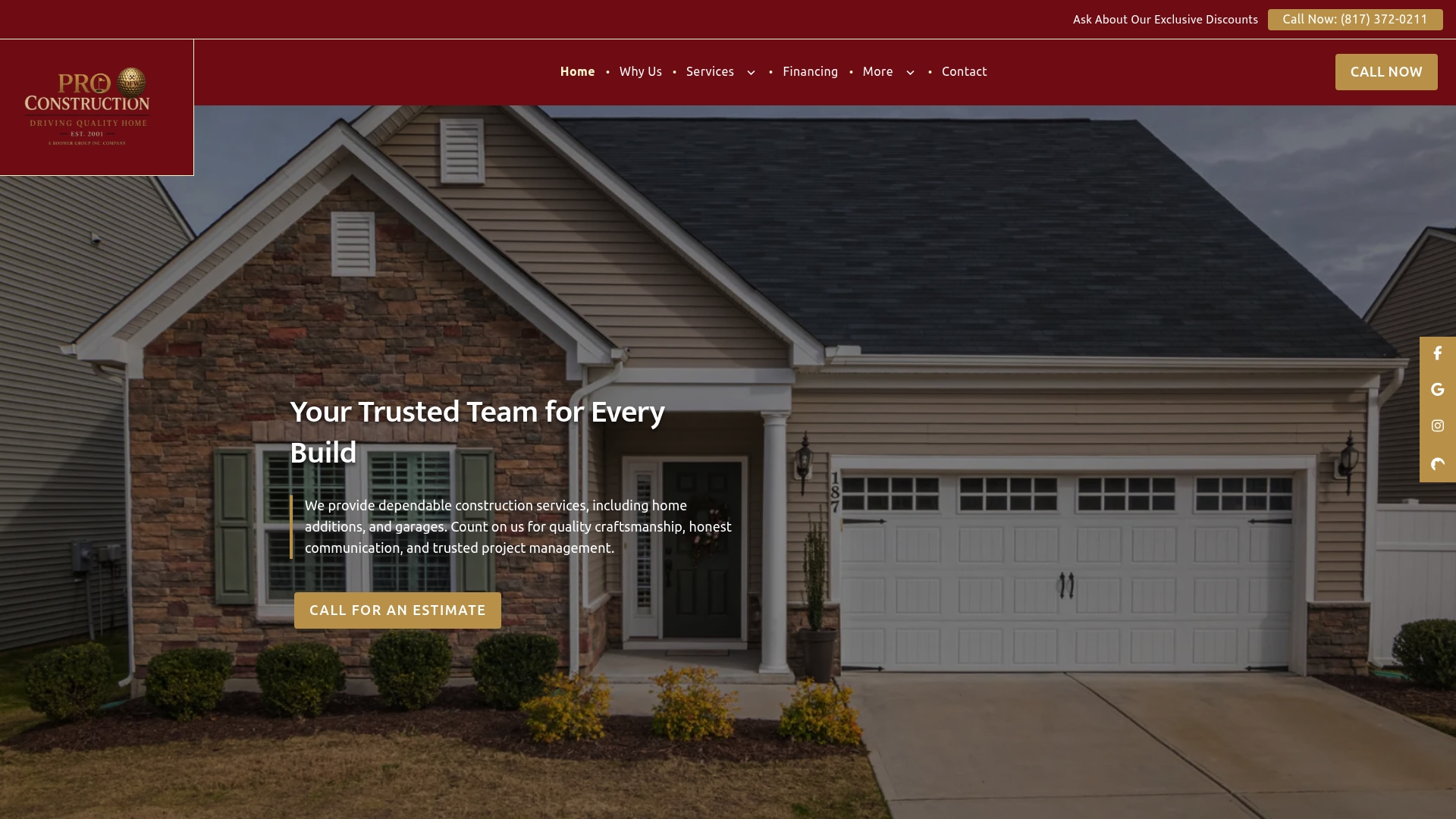
PRO Construction specializes in home additions and garage builds across the DFW area, with custom solutions and current discounts available for qualifying projects. The team manages every phase from design through final walkthrough, so you stay informed without managing the details yourself. Contact PRO Construction to schedule a consultation and get a clear picture of what your renovation can realistically achieve.
FAQ
What makes a home renovation successful?
A successful renovation solves a functional problem, stays within budget, and uses consistent design across all spaces. Projects that combine professional project management with a unified design-build team consistently deliver the best outcomes.
How much does a successful kitchen remodel cost?
A well-planned kitchen remodel can succeed for under $40,000 by avoiding structural changes and focusing on cabinetry, lighting, and countertops. One documented project spent $32,000 on labor and $6,500 on custom counters and produced a dramatically improved result.
Why do whole-home remodels take so long?
Whole-home remodels expanding to around 2,000 sq ft typically require 18 months because each phase depends on the one before it. Structural work, mechanical rough-in, and finish installation cannot overlap without creating costly rework.
What is a design-build team and why does it matter?
A design-build team handles both architectural design and construction under one contract. This structure eliminates the handoff gap between designer and contractor, which is where most renovation budgets overrun.
How do I preserve my home's character during a renovation?
Remove dated additions like drop ceilings and dark paneling to restore the home's original spatial quality. Use trim profiles and window placements that match the home's era rather than importing a style that conflicts with its structure.