
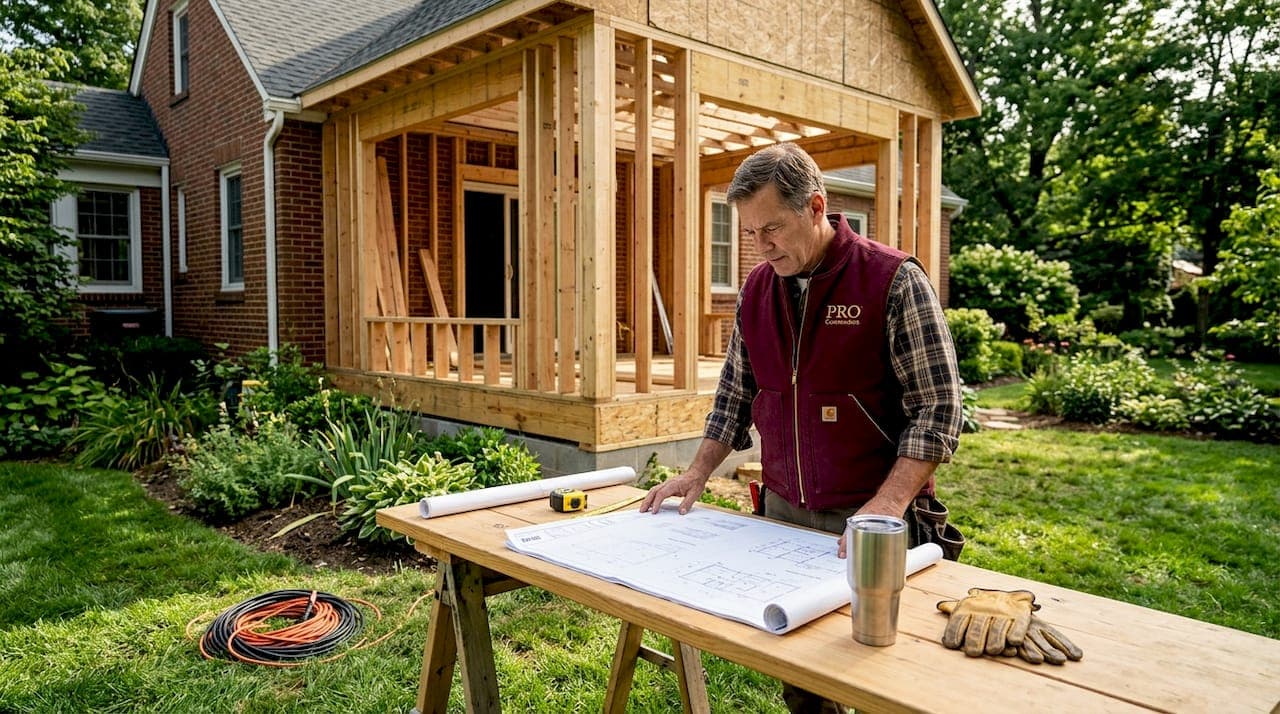
Many homeowners use "addition" and "renovation" interchangeably, but these two project types are fundamentally different in scope, cost, and legal requirements. Understanding what is an addition vs renovation before you commit to a project can save you thousands of dollars and months of frustration. One requires building entirely new space; the other updates what already exists. Get them confused, and you may budget for the wrong thing, pull the wrong permits, or hire a contractor without the right expertise for your actual project.
Table of Contents
- Key takeaways
- What is an addition vs renovation: core definitions
- Costs, timelines, and benefits compared
- Building codes, permits, and the grandfathering myth
- How to decide: addition or renovation
- My honest take after 25 years of construction projects
- Ready to plan your project in North Texas?
- FAQ
Key takeaways
| Point | Details |
|---|---|
| Additions create new square footage | Building a new room, floor, or extension expands your home's physical footprint. |
| Renovations update existing space | Replacing cabinets, flooring, or fixtures improves a room without changing its size. |
| Cost and timeline differ significantly | Additions typically cost $125 to $375 per square foot, while renovations are usually less expensive and faster. |
| Permits and codes apply differently | Additions must meet full current building codes; renovations trigger compliance only for altered areas. |
| Your decision depends on your goals | If you need more room, an addition is the answer; if you need a better room, a renovation often suffices. |
What is an addition vs renovation: core definitions
The clearest way to separate these two concepts is to ask one question: are you building new space, or improving existing space?
A home addition creates square footage that did not previously exist. Additions involve new foundation, framing, utility connections, and full structural integration with your existing home. Common examples of home additions include building a new master bedroom, adding a second story, constructing a detached garage, or extending your living room outward. The new space is genuinely new construction attached to or built alongside your home.
A renovation updates or improves space that already exists, without changing the home's footprint. Renovations can include cabinet replacements, paint, and flooring refreshes without any structural expansion. Repainting your living room, replacing kitchen countertops, upgrading bathroom tile, or installing new windows all qualify as renovations.
There is a third term worth clarifying: a remodel. Homeowners often confuse repairs, renovations, and remodels, but remodels involve structural changes such as removing a load-bearing wall to open up a floor plan. A remodel changes how a space functions or flows without adding new square footage. Think of it as sitting between a renovation and an addition on the complexity scale.
Pro Tip: If you are unsure whether your project is a renovation or a remodel, ask your contractor whether any walls, ceilings, or structural elements will be altered. If yes, it is a remodel, and the permit and code requirements will reflect that.
Costs, timelines, and benefits compared
Understanding the difference between addition and renovation projects becomes very practical when you look at money and time.
What additions cost and deliver
A 20x20 room addition averages $125 to $375 per square foot, meaning a modest addition can run anywhere from $50,000 to $150,000 depending on your foundation type, finishes, and local labor costs. That is a significant investment, but additions deliver something renovations cannot: actual new rooms. If your family has outgrown your home and you need a fourth bedroom or a dedicated home office, no amount of renovation will solve that problem.
Additions also carry strong long-term value in many markets. More square footage typically means a higher appraised value, which matters when you sell or refinance.
What renovations cost and deliver
Renovations tend to be less expensive and quicker than additions, and they can dramatically improve how your home looks and functions. A kitchen renovation, for example, can transform an outdated space into something modern and efficient without touching the walls. The 2025 Cost vs. Value Report found that clever reconfiguration of existing space can sometimes yield better ROI than costly additions, particularly in competitive real estate markets.

One underrated option: finishing an unfinished basement can cost a fraction of what a new addition runs while adding significant livable square footage. It is technically a renovation since you are improving existing structure, but the functional result feels like gaining a whole new floor.
Side-by-side comparison
| Factor | Home addition | Renovation |
|---|---|---|
| Square footage change | Yes, increases footprint | No change to footprint |
| Typical cost range | $50,000 to $150,000+ | $5,000 to $75,000+ |
| Timeline | 3 to 6+ months | 2 weeks to 3 months |
| Permits required | Yes, including zoning review | Yes, for structural or system work |
| Disruption level | High | Low to moderate |
| ROI potential | High in growing markets | High for kitchens and bathrooms |
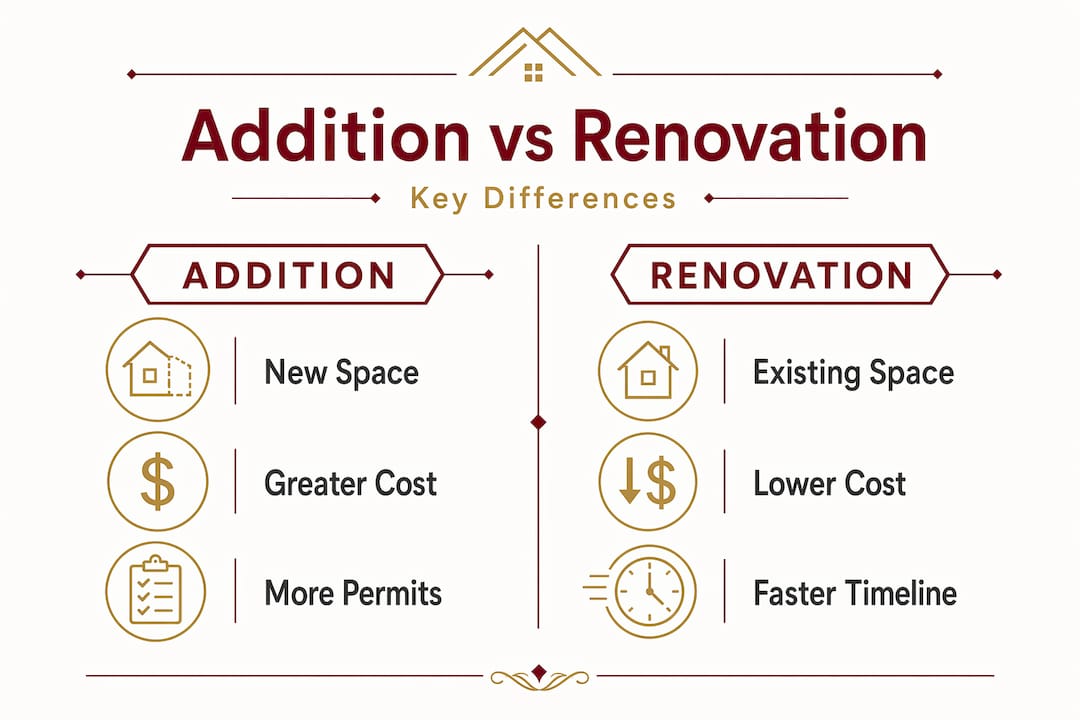
Renovations are often staged, which lets you stay in the home during the project but can stretch the total timeline if you are tackling multiple rooms.
Pro Tip: When comparing home addition vs renovation costs, always get your contractor to break out the permit fees separately. In North Texas, permit costs for additions can add $1,500 to $5,000 or more to your budget, and many homeowners are caught off guard.
Building codes, permits, and the grandfathering myth
This is where most homeowners run into expensive surprises, and it is worth spending real time here.
Additions and renovations both require permits, but the approval process and requirements are very different. Additions are treated as new construction. That means every element of the new structure, from the foundation to the electrical panel, must comply with current building codes in full. There are no exceptions for the new portion of your home.
Renovations work differently. Code upgrades during renovations typically apply only to altered areas, unless the scope of work is substantial. This is where the concept of "grandfathering" comes in, and it is widely misunderstood.
What grandfathering actually means
Grandfathering means existing nonconforming elements can remain unless the occupancy changes or substantial work triggers an upgrade requirement. In plain terms: if your 1970s home has wiring that would not pass today's code, you do not have to rewire the entire house just because you are renovating your kitchen. The existing wiring in untouched rooms stays as is.
But here is what catches homeowners off guard. Code compliance may require upgrading undamaged building portions if a safety concern is identified during the renovation, or if the scope of your project is classified as "substantial." The threshold for "substantial" varies by jurisdiction, but it often kicks in when renovation costs exceed a percentage of the home's assessed value.
Always ask your contractor and your local permit office whether your planned renovation scope could trigger whole-house code compliance. Finding out after the walls are open is far more costly than asking the question upfront.
Key points to understand before you start:
- Additions must meet all current codes for new construction, no exceptions.
- Renovations trigger code compliance only in the areas being altered, under normal circumstances.
- Safety-related deficiencies discovered during any project may require correction regardless of scope.
- Zoning rules affect additions more than renovations. Setbacks, lot coverage limits, and height restrictions all apply to new construction.
- Consulting a licensed contractor before finalizing your plans is the most reliable way to understand what compliance will look like for your specific project.
How to decide: addition or renovation
Knowing the difference between addition and renovation is useful. Knowing which one is right for your situation is what actually moves the project forward. Here is a practical framework for making that call.
-
Define your actual problem. Are you short on space, or unhappy with how your existing space looks and functions? If your family needs another bedroom, a renovation will not solve that. If your kitchen feels dated and cramped but is actually large enough, a renovation is the right tool.
-
Set a realistic budget. Use the cost ranges above as a starting point. If your budget is under $30,000, a full addition is unlikely to be feasible. A well-planned renovation, or a targeted remodel, will deliver more value at that price point.
-
Check your lot and zoning. Additions require physical space on your property. North Texas municipalities have setback rules that dictate how close to property lines you can build. Pull your property survey and check local zoning before you fall in love with an addition plan that your lot cannot accommodate.
-
Think about timeline and disruption. Additions are major construction events. Expect noise, dust, and limited access to parts of your home for months. Renovations, while still disruptive, are generally contained and faster. If you have young children or work from home, that difference matters.
-
Consider doing both at once. Additions and remodels done simultaneously allow more holistic results and more efficient construction compared to separate projects. If you are already opening walls for an addition, it is often cost-effective to renovate adjacent spaces at the same time.
Pro Tip: Before hiring anyone, review the 2026 homeowner's buying guide for home additions. It covers how to evaluate contractor bids, what questions to ask, and how to spot red flags in proposals.
My honest take after 25 years of construction projects
After working on hundreds of residential projects across North Texas, I have seen the same pattern repeat itself. Homeowners come in with a clear vision, a rough budget, and a firm belief that their project is "just a renovation." Then the permit office or a structural inspection reveals something that changes the entire scope.
What I have learned is this: the line between a renovation and an addition is not always clean in practice. A homeowner who wants to "just add a bathroom" quickly discovers they need new plumbing runs, possibly a permit for new electrical, and in some cases a variance from the city if the new bathroom footprint extends beyond the existing structure. That is no longer a renovation. It is an addition, with all the cost and code requirements that come with it.
I also see homeowners underestimate how much value a well-executed renovation delivers. They assume bigger is always better and push for additions when a smart structural renovation of their existing space would have solved the problem for half the cost.
My advice: start with an honest conversation about what problem you are actually trying to solve. Then bring in a contractor who will tell you the truth about what that solution actually requires, not just what you want to hear.
— PRO
Ready to plan your project in North Texas?
Whether you are leaning toward an addition or a renovation, getting the right contractor in your corner from day one makes the difference between a project that stays on budget and one that spirals. Proconstructiontx has spent over 25 years building and renovating homes across Keller, Fort Worth, and the broader North Texas area, earning a top 1% BuildZoom ranking among Texas contractors.

From full home additions in Fort Worth to targeted renovations, the Proconstructiontx team handles permitting, code compliance, and project management so you do not have to figure it out alone. Senior citizens, first responders, teachers, and military personnel can ask about available discounts. Reach out to PRO Construction's Keller team to get a consultation tailored to your property and goals.
FAQ
What is the main difference between an addition and a renovation?
An addition creates new square footage by building new rooms or extending the structure, while a renovation updates or improves existing space without changing the home's footprint.
Do home additions require more permits than renovations?
Yes. Additions are treated as new construction and require full building code compliance, zoning review, and often a more involved permit process than standard renovations.
Can a renovation turn into an addition?
It can. If your renovation plans extend beyond the existing structure or require new foundation work, the project crosses into addition territory and will be subject to new construction code requirements.
How do I know if my project needs a permit?
Any structural change, new electrical or plumbing work, or project that extends the home's footprint requires a permit. When in doubt, check with your local municipality or ask your contractor before starting work.
Is it cheaper to renovate or add on to a home?
Renovations are almost always less expensive. A home addition typically costs $125 to $375 per square foot, while renovations can deliver significant improvements at a fraction of that cost, depending on scope.
Recommended
- Home Addition Contractors Keller, TX | Ask About Our Discounts!
- Structural Renovation Services in Tarrant County: The Homeowner’s Guide - PRO Construction
- Home Addition Contractors in Fort Worth: Your Guide to Expanding Your Space in 2026 - PRO Construction
- Home Addition Contractor in Keller, TX: The 2026 Homeowner’s Buying Guide - PRO Construction