

An ADU, or accessory dwelling unit, is a self-contained residential unit built on the same lot as a single-family home, complete with its own kitchen, bathroom, sleeping area, and separate entrance. Also called granny flats, in-law suites, or backyard cottages, these structures give homeowners a flexible way to add living space, generate rental income, or house family members without buying a second property. A permitted ADU can increase home value by up to 30%, making it one of the most financially productive additions a homeowner can make. Understanding your options, costs, and local rules before breaking ground is what separates a smooth project from a costly one.
What is an ADU and what types are available?
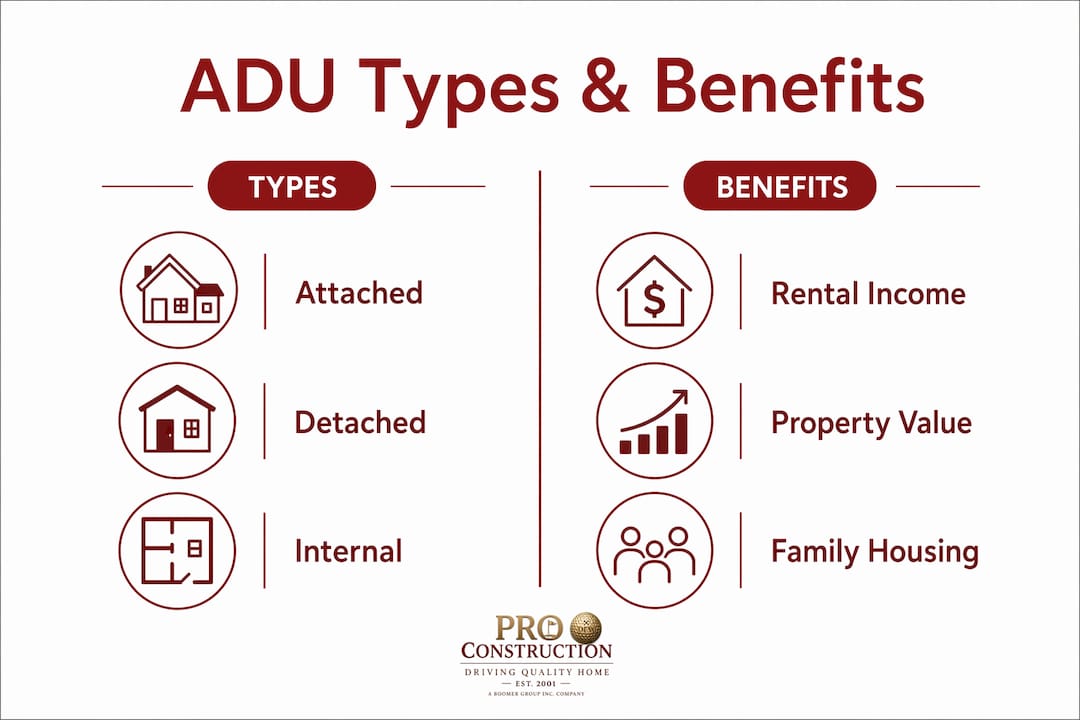
Accessory dwelling units fall into three main configurations. Each type carries different cost profiles, infrastructure demands, and zoning implications. Knowing the difference before you plan saves time and money.
Attached ADUs share a wall with the primary home. They are typically the most affordable option because they connect to existing utility systems. Common uses include converting a garage, adding a side extension, or building above an attached garage.
Detached ADUs are freestanding structures on the same lot, such as a backyard cottage or a converted workshop. They offer the most privacy for tenants or family members. However, detached units often require costly infrastructure work like trenching for water, sewer, and electrical lines, adding unexpected expenses over attached units.
Internal ADUs convert existing space within the home itself. Basement apartments and garage conversions are the most common examples. These tend to be the lowest-cost option because the structure already exists, though they may require significant work to meet habitability codes.
| Type | Average Cost Range | Key Advantage | Main Challenge |
|---|---|---|---|
| Attached ADU | $80,000–$200,000 | Shares utilities with main home | Limited privacy |
| Detached ADU | $120,000–$350,000+ | Maximum privacy and flexibility | High infrastructure costs |
| Internal ADU | $50,000–$150,000 | Lowest construction cost | Space and ceiling height limits |
Pro Tip: If you are converting an existing garage or basement, confirm ceiling height and egress window requirements with your local building department before spending a dollar on design. Many conversions stall at this step.
Most jurisdictions cap ADU size between 500 and 1,200 square feet, though limits vary widely by state and municipality. Always verify local rules before committing to a design.
How much does it cost to build an ADU?
The cost to build an ADU typically ranges between $150 and $600 per square foot, depending on type, materials, and local labor rates. That spread represents a 400% variance, which means a 600-square-foot unit could cost anywhere from $90,000 to $360,000. The gap is wide, but the factors driving it are predictable.
Several cost drivers consistently push projects toward the higher end:
- Utility connections: Running new water, sewer, and electrical lines to a detached structure can add $15,000–$50,000 alone.
- Site conditions: Sloped lots, poor soil, or limited access increase foundation and grading costs.
- Permit and impact fees: These vary by city but can range from a few hundred to tens of thousands of dollars.
- Design and engineering: Custom plans from an architect typically cost $5,000–$20,000 depending on complexity.
- Finishes: Upgraded kitchens, bathrooms, and flooring can add 20–30% to base construction costs.
For local North Texas homeowners, PRO Construction offers a detailed breakdown in its Tarrant County ADU cost guide that reflects current regional labor and material rates.
Pro Tip: Prefabricated ADU plans from companies like Dvele or Cover reduce design costs and speed up permitting because the plans are pre-engineered. They are not right for every lot, but they can cut weeks off your timeline.
Converting an existing structure, such as a detached garage, almost always costs less than new construction. If your property already has a usable footprint, that is your lowest-cost starting point. Weigh the savings against any rental income projections to determine which path makes the most financial sense.
What are the ADU regulations and permit requirements in 2026?
ADU regulations vary by state and municipality, but 2026 has brought meaningful updates that favor homeowners. California remains the most active state for ADU law reform and serves as a useful benchmark for understanding where national trends are heading.
Key 2026 regulatory updates include:
- Permit timelines: California now mandates a 15-business-day completeness review for ADU permit applications, with automatic approval if the deadline is missed. A strict 60-day permit approval timeline is also enforced. This prevents municipalities from stalling projects indefinitely.
- Size thresholds: Most states allow ADUs up to 850 square feet for studios and one-bedrooms, and up to 1,000 square feet for two-bedroom units, regardless of lot size restrictions.
- Fee exemptions: Many jurisdictions now waive or reduce impact fees for ADUs under 750 square feet, making smaller units significantly more affordable to permit.
- Owner-occupancy rules: Several states, including California, have suspended owner-occupancy requirements through at least 2026, allowing investors and non-resident owners to build ADUs on rental properties.
- State preemption: State law often supersedes local zoning to protect ADU development rights. Homeowners can legally challenge overly restrictive local ordinances that conflict with state-level protections.
Permits are not optional. Building without proper permits risks insurance denial and creates disclosure problems during resale, sometimes forcing costly retroactive compliance or even demolition.
Even in states with fewer ADU-friendly laws than California, the direction of regulation is clear. More states are adopting streamlined permitting to address housing shortages. Staying current with your local planning department before you design is the single most important regulatory step you can take.
What are the benefits and challenges of adding an ADU?
The benefits of ADUs extend well beyond extra square footage. Experts recommend treating an accessory dwelling unit as a hybrid asset that provides immediate cash flow and long-term market competitiveness, not just a traditional home improvement. That framing changes how you evaluate the investment.
Core benefits include:
- Rental income: A market-rate ADU in most U.S. metros can generate $1,000–$2,500 per month in rent, offsetting mortgage or construction loan payments.
- Multigenerational housing: ADUs let aging parents or adult children live nearby with independence, reducing care costs and family stress.
- Property value: A permitted ADU can add significant buyer appeal and rental income potential even when the official assessed value increase is modest. Buyers perceive the income potential and pay a premium for it.
- Flexibility: An ADU can serve as a rental today, a home office next year, and a caregiver suite a decade from now.
Challenges to plan for:
- Upfront construction costs are substantial and financing options require careful planning.
- Zoning approval, even in permissive states, adds time to your project timeline.
- Managing a rental unit adds landlord responsibilities, including maintenance and tenant relations.
- Construction complexity increases with detached builds and difficult site conditions.
Pro Tip: The assessed property tax increase from an ADU is often lower than the market value it adds. Tax assessors frequently lag behind market conditions, so your tax bill may rise less than you expect while your resale price rises more.
The homeowners who benefit most from ADUs are those with clear goals: consistent rental income, a specific family housing need, or a long-term plan to sell a property with built-in income appeal. Vague goals lead to underused units and regret.
How to build an ADU: critical steps for success
Most failed or delayed ADU projects result from skipping the planning phase and ignoring zoning or utility constraints. A feasibility study before any design work is the single highest-return step in the entire process.
Follow these steps to keep your project on track:
- Run a zoning and feasibility check. Confirm setback requirements, lot coverage limits, height restrictions, and utility capacity before hiring anyone. Your local planning department can provide this information, often for free.
- Define your use case. Rental unit, family suite, or home office each require different layouts, finishes, and permitting paths. Lock this in before design begins.
- Hire a licensed contractor with ADU experience. General contractors without ADU experience routinely underestimate infrastructure costs and permit complexity. Review credentials, check references, and confirm they have completed permitted ADU projects in your jurisdiction. PRO Construction's guide on hiring a contractor with ADU experience walks through exactly what to look for.
- Complete design and engineering. Work with an architect or designer to produce permit-ready drawings. Prefab plan sets can reduce this cost if your lot allows it.
- Submit for permits and respond promptly. Delays in responding to plan check comments are the most common reason projects miss their permit windows.
- Manage construction milestones. Schedule inspections at each required phase: foundation, framing, rough mechanical, and final. Missing an inspection can require destructive re-inspection later.
Pro Tip: Ask your contractor for a written project schedule with inspection milestones before signing a contract. Contractors who cannot produce one are not organized enough for a permitted ADU build.
Selecting the right builder matters as much as the design itself. PRO Construction's ADU builder guide for Fort Worth covers how to vet candidates and what questions to ask before signing anything.
Key Takeaways
An ADU is one of the most financially productive additions a homeowner can make, provided it is permitted, planned carefully, and matched to a clear use case.
| Point | Details |
|---|---|
| ADU types vary significantly | Attached, detached, and internal ADUs differ in cost, privacy, and infrastructure needs. |
| Costs range widely | Expect $150–$600 per square foot; detached units carry the highest infrastructure costs. |
| Permits are non-negotiable | Unpermitted ADUs risk insurance denial, resale disclosure problems, and forced demolition. |
| Regulations favor homeowners in 2026 | State laws increasingly override local restrictions, and permit timelines are now enforced. |
| ADUs are hybrid assets | They generate rental income, attract buyers, and add flexible living space simultaneously. |
Why ADUs are one of the smartest property moves I see in 2026
After 25 years of building home additions and accessory structures across North Texas, I have watched homeowners treat ADUs as a last resort when they should be treating them as a first move. The families who build them early, with a clear purpose and a licensed team, consistently outperform those who wait.
What I find most underappreciated is the flexibility angle. A rental ADU today can become a parent's residence in five years and a selling point in ten. No other single addition gives you that range of options. The market is also shifting. Buyers in North Texas are actively searching for properties with income potential, and a permitted ADU is one of the clearest signals a listing can send.
My honest observation: the homeowners who struggle with ADU projects almost always skipped the feasibility phase. They fell in love with a design before confirming their lot could support it. The planning work is unglamorous, but it is where the project is actually won or lost. Treat it accordingly.
— PRO
Build your ADU with PRO Construction
PRO Construction has spent over 25 years building home additions and accessory structures across North Texas, with a top 1% ranking on BuildZoom to back it up. The team understands 2026 permit requirements, local zoning conditions, and the infrastructure realities that catch other contractors off guard. Whether you are planning a detached backyard cottage or converting an existing garage, PRO Construction provides transparent project management from feasibility through final inspection. Explore home addition services in Keller to request a personalized quote and find out what your property can support. Your ADU project deserves a builder who has done this before.
FAQ
What is an ADU in simple terms?
An ADU is a self-contained living unit on the same lot as a single-family home, with its own kitchen, bathroom, and entrance. Common names include granny flat, in-law suite, and backyard cottage.
How much does an ADU cost to build?
Construction costs typically range from $150 to $600 per square foot, depending on type and local labor rates. A finished 600-square-foot unit commonly costs between $90,000 and $360,000 all in.
Do I need a permit to build an ADU?
Yes. Building without a permit risks insurance denial and creates legal disclosure problems at resale, sometimes requiring costly retrofits or demolition.
Will an ADU increase my property taxes?
An ADU may increase your assessed value, but assessors often lag behind market conditions. The resale and rental income premium typically exceeds the tax impact.
What ADU regulations changed in 2026?
California now enforces a 60-day permit approval deadline and a 15-business-day completeness review. Many states have also reduced impact fees and suspended owner-occupancy requirements to encourage ADU construction.