

A construction bid is a formal written proposal submitted by a contractor to perform a specific building project, detailing costs, scope of work, and timelines based on your project documents. The industry also refers to this as a tender or bid proposal, and understanding the difference between a rough estimate and a true construction bid can save you thousands of dollars on any renovation or new build. Most homeowners encounter the construction bidding process for the first time when planning a home addition or major renovation, and without a clear picture of how bids work, it is easy to make costly mistakes. This guide breaks down every stage, from what goes into a bid to how you should evaluate competing offers.
What is a construction bid and what does it include?
A construction bid is the formal contractor submission that translates your project blueprints, specifications, and a Bill of Quantities (BOQ) into a priced proposal. It is not a ballpark figure. It is a structured document that commits a contractor to a defined scope at a stated price.
A complete bid package typically contains the following elements:
- Cost breakdown: Line items covering materials, labor, overhead, and the contractor's profit margin. This level of detail lets you see exactly where your money goes.
- Scope of work: A written description of every task the contractor agrees to perform. Anything not listed here is not included, which is where disputes most often start.
- Bill of Quantities (BOQ): A standardized pricing document that lists material and labor quantities so every bidder prices the same scope. Without a BOQ, you cannot make a fair comparison between contractors.
- Schedule: Projected start and completion dates, along with major milestones.
- Subcontractor details: Names or categories of specialty trades the contractor plans to use, such as electricians or plumbers.
- Legal documents: Bid bonds, insurance certificates, and licensing information.
A bid differs from a broader proposal. Bids focus on pricing and basic project details, while proposals include methods, design approaches, and project management plans. For a straightforward home addition, you will usually receive bids. For a complex design-build project, you may receive full proposals.
Pro Tip: Ask every contractor to use the same scope document before submitting their bid. When bidders price different assumptions, comparing their numbers is meaningless.

How does the construction bidding process work?
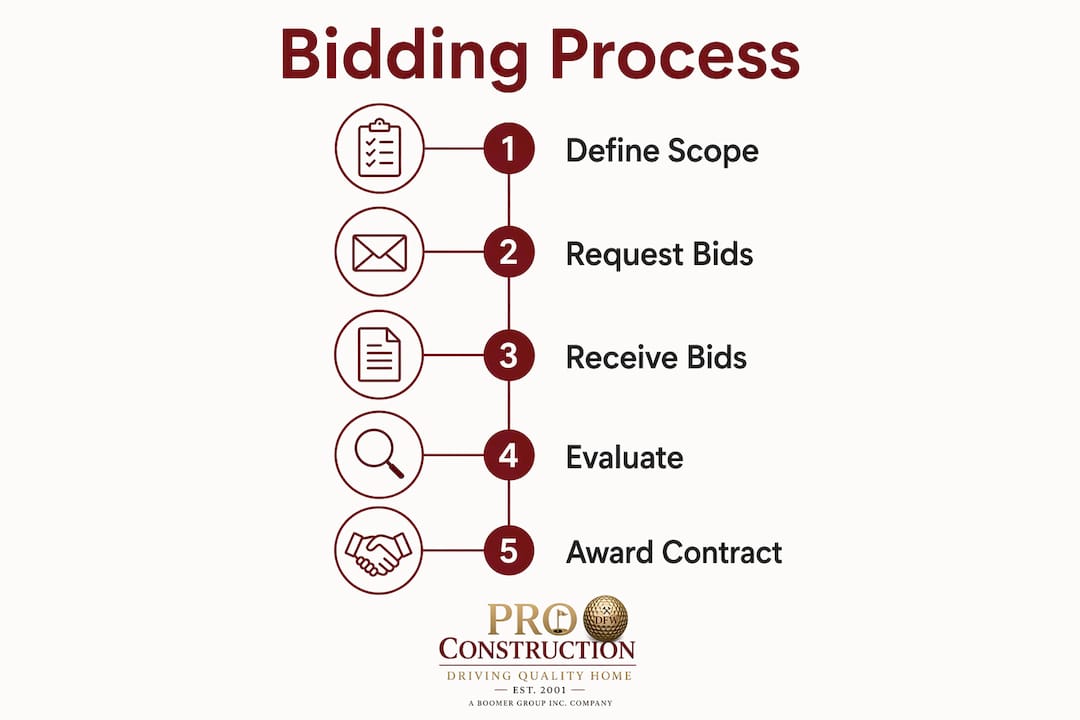
The bidding process follows five phases: solicitation, submission, evaluation, contract formation, and project delivery. Knowing where you are in this sequence helps you set realistic expectations and avoid being rushed into a bad decision.
-
Solicitation. You, the property owner, issue a formal request to contractors. This document is called an Invitation for Bid (IFB), a Request for Quote (RFQ), or a Request for Proposal (RFP), depending on how much flexibility you want to give bidders. An IFB is the most structured option and works best when your plans are fully drawn and your scope is locked.
-
Bid preparation. Contractors study your project documents, visit the site, and assemble their cost estimates. This stage involves quantity takeoffs, supplier quotes, and subcontractor pricing. Serious contractors spend significant time here, which is why giving them at least two to three weeks to respond is standard practice.
-
Bid submission. Contractors deliver their complete bid packages, including scope, schedule, cost breakdowns, and required legal documents, by your stated deadline. Late bids are typically disqualified.
-
Evaluation and selection. You review all submitted bids against your criteria. Price matters, but it is not the only factor. Contractor qualifications, references, timeline feasibility, and compliance with your specifications all carry weight.
-
Contract formation. Once you select a contractor, both parties sign a formal construction contract that incorporates the bid terms. The bid becomes legally binding at this point.
Private projects like home additions give you full discretion at every stage. Public projects, such as government buildings, follow stricter rules that often require awarding to the lowest qualified bidder. As a homeowner, you have the flexibility to weigh factors beyond price, and you should use it.
What types of construction bids are common?
Not every bidding situation works the same way. The three primary bidding models are open competitive tendering, selective tendering, and negotiated tendering. Each carries different trade-offs for homeowners.
| Bid type | How it works | Best for | Key risk |
|---|---|---|---|
| Open competitive | Any licensed contractor can submit a bid | Large projects needing maximum price competition | Higher volume of bids to evaluate; variable quality |
| Selective (invited) | You invite a short list of pre-vetted contractors | Homeowners who want quality control from the start | Fewer price options; requires upfront vetting effort |
| Negotiated | You work directly with one contractor to agree on price and scope | Repeat clients or design-build relationships | No competitive pressure on pricing |
| Fixed price | Contractor commits to a set total cost | Projects with fully defined scope and drawings | Contractor may cut corners if costs run high |
| Cost-plus | You pay actual costs plus an agreed fee or percentage | Projects where scope is still evolving | Final cost is uncertain until completion |
For most homeowners planning a home addition or garage build, selective bidding is the practical choice. You identify three to five contractors with relevant experience, invite them to bid, and compare their submissions. This approach gives you competitive pricing without sorting through unqualified submissions.
Bid bonds apply in all three models when the project value warrants them. A bid bond of 5 to 10% of the bid amount guarantees the contractor will honor their price and sign the contract if selected. If they back out, you can claim the bond. This protection matters more than most homeowners realize.
Why the lowest bid is rarely the best choice
The lowest number on a bid sheet is the most dangerous number in construction. Overly low bids can lead to contractor insolvency, abandoned projects, or a cascade of change orders that push the final cost well above the next-highest bid you passed on.
Here is what to examine beyond the bottom line:
- Scope completeness. Does the bid cover everything your project requires, or has the contractor excluded items to appear cheaper? Missing allowances for permits, site cleanup, or finishing work are common omissions.
- Apples-to-apples comparison. Clearly defined allowances and exclusions are the only way to compare bids fairly. A bid without stated exclusions is hiding something.
- Contractor qualifications. Years of experience, relevant project history, and verifiable references matter as much as price. A contractor who has built ten home additions in your area understands local permitting, soil conditions, and subcontractor availability in ways a generalist does not. Review reputable contractor qualities before making any selection.
- Bid bond presence. A contractor who can post a bid bond has been vetted by a surety company. Bonding signals financial capacity and commitment to perform at the quoted price. A contractor who cannot or will not provide a bond on a significant project is a red flag.
- Assumptions and exclusions. Ambiguity in bid scope is the leading cause of change orders and post-award disputes. Ask every contractor to list their assumptions in writing before you sign anything.
Pro Tip: Create a simple spreadsheet with every line item from your project scope. Ask each bidder to price each line separately. This one step eliminates most apples-to-oranges confusion and reveals which contractor actually read your documents.
Understanding residential construction contracts before you reach the signing stage gives you a significant advantage when negotiating terms after bid selection.
Key takeaways
A construction bid is only as reliable as the scope document behind it. Homeowners who invest time in clear project documentation receive accurate bids, avoid change orders, and select contractors on merit rather than guesswork.
| Point | Details |
|---|---|
| Definition matters | A construction bid is a formal, priced proposal tied to specific project documents, not a rough estimate. |
| BOQ enables fair comparison | A Bill of Quantities forces all bidders to price the same scope, making comparisons meaningful. |
| Five-phase process | Solicitation, submission, evaluation, contract formation, and delivery are the standard stages for any project. |
| Bid type affects outcome | Selective bidding gives homeowners quality control; negotiated bidding sacrifices price competition. |
| Lowest bid carries risk | Evaluate contractor qualifications, scope completeness, and bid bond capacity alongside price. |
What 25 years of bids taught me about homeowner mistakes
After working on hundreds of home additions and garage builds across North Texas, the pattern I see most often is this: homeowners fixate on the total price and ignore everything else on the page. That instinct is understandable. Construction costs are significant, and saving money feels like the responsible move. But the bid price is not the project cost. The project cost is what you pay when the job is done, including every change order, every delay, and every repair from substandard work.
The contractors who submit the lowest bids are frequently the ones who have not read your documents carefully, have excluded items they hope you will not notice, or have priced labor so thin that they will cut corners when material costs rise. I have seen homeowners save $8,000 on a bid and spend $20,000 fixing the result.
What actually protects you is documentation. When a contractor lists their assumptions, exclusions, and allowances in writing, you can hold them to it. When they refuse to provide that detail, walk away. A contractor who is confident in their numbers has no reason to hide them.
The other thing most homeowners skip is the site visit. Require every bidder to walk the property before submitting. A contractor who bids without seeing the site is guessing, and you will pay for those guesses later. The subcontractor sourcing decisions a contractor makes before the project even starts often determine whether your timeline holds.
Bid bonds are not bureaucratic paperwork. They are the clearest signal a contractor can send that they stand behind their number. If a contractor balks at providing one on a project over $50,000, that tells you something important about their confidence in their own bid.
— PRO
Ready to get a bid you can actually trust?
Planning a home addition or garage build in North Texas means navigating a bidding process that can feel overwhelming without the right partner.
PRO Construction brings over 25 years of experience and a top 1% BuildZoom ranking to every project in the Keller and Fort Worth area. The team provides transparent, itemized bids with clearly stated assumptions so you always know what you are paying for and why. Whether you are adding a room, building a garage, or expanding your living space, PRO Construction handles the full project from bid to final walkthrough. Ask about current discounts when you contact the team for your home addition estimate in Keller, TX. Homeowners in Fort Worth can also explore the detailed Fort Worth home addition guide to understand what their project might involve before the first contractor walks through the door.
FAQ
What is a construction bid in simple terms?
A construction bid is a written offer from a contractor that states exactly what work they will do, what materials they will use, and what the total cost will be. It is based on your project plans and specifications, not a general estimate.
How many bids should a homeowner get?
Three to five bids from pre-vetted contractors is the standard recommendation for residential projects. Fewer bids limit your ability to compare pricing and qualifications; more bids create unnecessary complexity without proportional benefit.
What is the difference between a bid and a proposal?
A bid focuses on pricing and scope for a defined project, while a proposal includes broader information such as design approach, project management methods, and timelines. Homeowners with fully drawn plans typically receive bids; those in early planning stages may receive proposals.
Do I have to accept the lowest construction bid?
No. As a private property owner, you have full discretion to select any contractor based on qualifications, experience, scope clarity, and price. Evaluating bids on multiple criteria protects you from low-ball submissions that lead to cost overruns.
What is a bid bond and do I need one?
A bid bond is a financial guarantee, typically 5 to 10% of the bid amount, that the contractor will honor their price and sign the contract if selected. For projects over $25,000 to $50,000, requiring a bid bond is a reasonable protection that also signals contractor reliability.
Recommended
- Design Build Project Management: The Homeowner’s Guide to Stress-Free Construction - PRO Construction
- Residential Construction Contracts: A Homeowner’s Guide for Keller & North Texas - PRO Construction
- Qualities of Reputable Local Contractors: A Homeowner's Guide
- Home Addition Contractor Best Practices for Homeowners