

Most homeowners assume a contractor is a contractor. You call one, they show up, the work gets done. But that thinking leads to mismatched hires, blown budgets, and projects that need to be redone. The role of contractor specialization explained properly changes how you approach every renovation or build. Specialists bring deep training, dedicated tools, and trade-specific certifications that a generalist simply cannot replicate. Whether you are adding a room, replacing a roof, or rewiring a kitchen, the type of contractor you hire shapes the final result more than almost any other decision you will make.
Table of Contents
- Key Takeaways
- The role of contractor specialization explained
- How specialization changes your project outcomes
- What to check before hiring a specialist
- How general contractors manage specialized trades
- Technology and niche focus in modern contracting
- My take after 25 years watching projects succeed and fail
- Work with specialists who know North Texas
- FAQ
Key Takeaways
| Point | Details |
|---|---|
| Specialization shapes results | Hiring the right specialist directly reduces errors, rework, and compliance failures on your project. |
| Specialists command premium pricing | Deep expertise and limited competition allow specialty contractors to charge more and deliver more. |
| Written proposals protect you | Detailed contracts covering scope, permits, timelines, and warranties are non-negotiable with any specialist hire. |
| General contractors coordinate trades | A skilled general contractor manages multiple specialists to keep your project on schedule and on budget. |
| Technology sharpens the edge | Specialty contractors using digital scheduling and maintenance tracking deliver more reliable, predictable outcomes. |
The role of contractor specialization explained
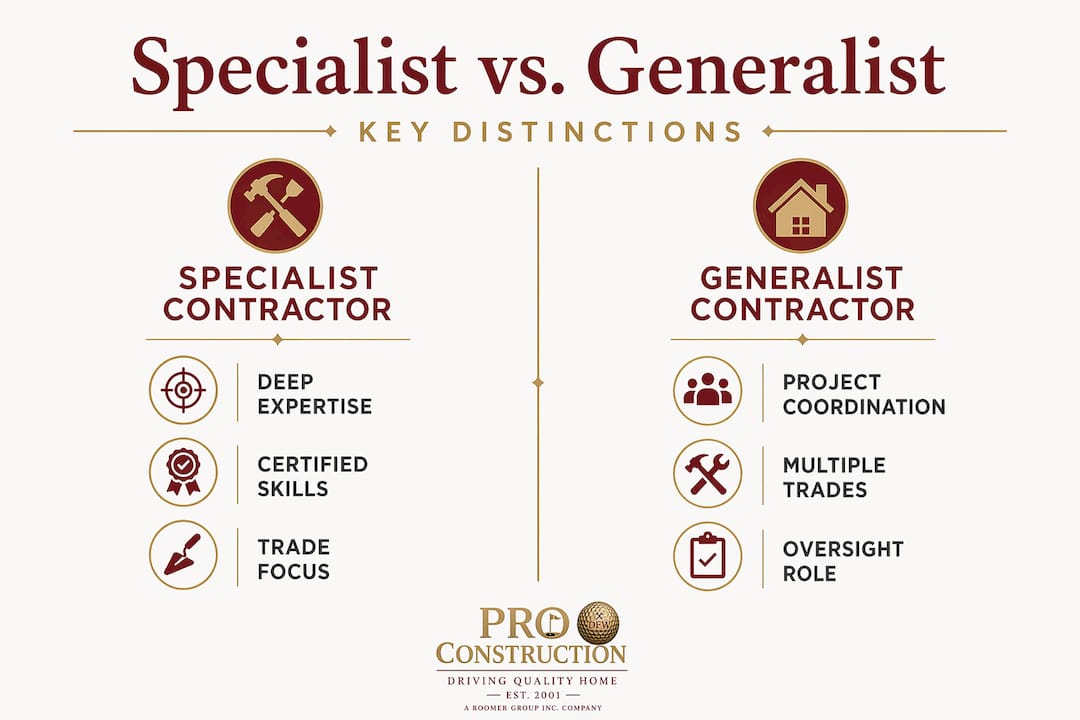
Contractor specialization is the difference between someone who knows construction broadly and someone who has spent years mastering one specific trade. A general contractor understands how a project fits together. A specialty contractor knows their slice of that project at a depth a generalist cannot match.
Here is how the main types break down:
- Electricians handle wiring, panels, outlets, and lighting systems. They carry licenses that require passing exams on electrical codes, safety standards, and load calculations.
- Plumbers specialize in water supply, drainage, and gas lines. Their work requires permits and inspections in most jurisdictions because mistakes carry serious safety consequences.
- HVAC technicians design, install, and service heating and cooling systems. Proper sizing and ductwork require calculations that go beyond general carpentry knowledge.
- Roofers work with specific materials, whether asphalt shingles, metal panels, or flat membrane systems. Niche roofing specialists like those handling high-slope metal roofing invest in equipment, training, and insurance that generalists cannot replicate.
- Masons work with brick, stone, and concrete, often on structural and aesthetic applications that require understanding load distribution and curing times.
- Structural carpenters and framers focus on the bones of a building, including load-bearing walls, beams, and floor systems.
The depth of training involved is significant. Specialty contractors typically complete apprenticeships of three to five years, earn trade-specific certifications, carry specialized insurance, and maintain familiarity with local building codes. That combination of credentials and hands-on repetition is what makes specialization meaningful rather than just a marketing label.
How specialization changes your project outcomes
This is where the importance of contractor specialization becomes concrete for your bottom line and your peace of mind.

Specialty contractors command higher margins because their expertise limits competition. When a homeowner faces a structurally complex addition or a high-cost electrical upgrade, they are not shopping on price alone. They are looking for the contractor who signals the least risk. That signal comes from specialization.
Here is a side-by-side look at how specialists and generalists typically compare on the metrics that matter most to homeowners:
| Factor | Specialist contractor | Generalist contractor |
|---|---|---|
| Technical depth | Deep, trade-specific expertise | Broad but surface-level knowledge |
| Code compliance | Manages permits and inspections in their trade | May rely on subcontractors for compliance details |
| Risk of rework | Lower due to practiced precision | Higher on complex or regulated tasks |
| Cost for complex work | Higher upfront, lower total cost | Lower upfront, higher total cost with corrections |
| Homeowner confidence | High on specialized, high-stakes work | High for straightforward, multi-trade oversight |
Specialty contractors take full responsibility for compliance, safety, and trade performance in their area. That accountability is not just professional pride. It protects you legally and financially when something goes wrong.
Pro Tip: When your project involves structural changes, electrical work, or anything requiring a permit, always hire a contractor whose specialty matches that specific trade. A general contractor can oversee the project, but the licensed specialist should be the one pulling the permit and executing the work.
What to check before hiring a specialist
Understanding contractor specialization benefits is only useful if you can translate it into a smarter hiring process. Here is what to actually do before signing anything:
- Request a detailed written proposal. Written proposals must break down labor, materials, permits, and timelines line by line. A vague one-page quote is a red flag regardless of how impressive the sales pitch was.
- Review their portfolio for project similarity. A contractor who has completed ten projects like yours is not the same as one who has done it once. Look for photos, project types, and complexity levels that match what you need.
- Verify licenses, certifications, and insurance. Homeowners should verify certifications and insurance before a single contract is signed. An unlicensed contractor can leave you holding liability for unpermitted work.
- Ask about local code familiarity. Building codes vary by municipality. A specialist who regularly works in your area will know the local inspectors, permit timelines, and common code variations.
- Read the contract for scope modification language. Projects change. The contract should spell out how changes are priced, approved, and documented. Missing this point is how scope creep turns a $40,000 addition into a $60,000 one.
- Ask about warranty coverage. What does the contractor warrant, for how long, and what does it cover? A specialist confident in their work will stand behind it in writing.
If a contractor hesitates to provide any of these, treat that hesitation as information. Specialists with strong track records do not usually resist documentation. Contracts must specify scope and warranty periods to protect your investment from the start.
Pro Tip: Ask every specialist candidate: "Have you pulled permits for this type of work in my city before?" The answer tells you immediately whether they know your local regulatory environment or are figuring it out on your dime.
How general contractors manage specialized trades
A general contractor is not a specialist in one trade. They are a specialist in coordination. Understanding this distinction is a core part of the contractor roles defined category that homeowners often overlook.
General contractors coordinate subcontractors, secure permits, order materials, and oversee compliance and scheduling across every trade on a project. When your addition requires framing, electrical, plumbing, HVAC, drywall, and roofing, a general contractor makes sure each specialist shows up in the right sequence, with the right materials, and without creating problems for the next trade.
The coordination function has measurable value:
- A framing crew that finishes before the HVAC rough-in is scheduled prevents the kind of rework where walls get torn open after insulation is installed.
- A general contractor who understands multiple trades reduces communication time between teams and catches conflicts before they become expensive problems.
- Effective general contractor coordination optimizes project timelines and reduces costly rework, which directly improves homeowner satisfaction.
For large multi-trade projects, consider a design-build approach. In that model, the same firm handles design and construction, which means specialists are integrated from the planning stage rather than hired reactively. Integrated design-build firms provide homeowners with coordinated risk mitigation by managing specialized trades early in the design phase, catching potential conflicts before a single nail is driven.
Technology and niche focus in modern contracting
The most successful specialty contractors in 2026 are not just technically skilled. They have built operational systems that make their work repeatable and reliable at scale. This is the side of contractor specialization most homeowners never see, but it affects your project directly.
Specialty contractors who build digital infrastructure for scheduling, maintenance tracking, and client communication can manage complex, multi-site demands without dropping details. When your contractor uses software to track permit deadlines, material deliveries, and subcontractor schedules, you are far less likely to receive a call saying a crew is two weeks late because someone forgot to order windows.
The benefits for you as a homeowner include:
- Fewer scheduling gaps. Digital scheduling tools reduce the idle time between trades, which cuts weeks off a project calendar.
- Proactive problem identification. Contractors who track maintenance and inspection timelines catch issues before they escalate into costly surprises.
- Better documentation. Tech-enabled specialists keep records of decisions, material specifications, and change orders, which protects both parties if a dispute arises.
Niche specialization also acts as a business moat for the contractor. The investment they make in certifications, equipment, and technology raises the floor of their service quality in ways a generalist with broader scope simply cannot match. For you, that means the specialist you hire has a strong financial and reputational reason to perform at a high level every time.
Engineering-focused workplace culture also plays into this. Firms that invest in technical talent and integrated technology are consistently better at early conflict identification, schedule adherence, and client communication.
My take after 25 years watching projects succeed and fail
I have seen the full spectrum. Homeowners who hired the cheapest contractor they could find and spent twice as much fixing the results. Investors who trusted a generalist with a structural addition and ended up with a failed inspection, a stop-work order, and a contractor who had already moved on to the next job.
What I have learned is that the biggest mistakes do not come from bad contractors in the obvious sense. They come from mismatched contractors. A skilled generalist handed a complex structural retrofit is not a bad person. They are the wrong person for that job. The damage looks the same either way.
The contrarian view I would push back on is the idea that hiring a specialist always costs more. In my experience, the opposite is true over the life of a project. A specialist gets it right the first time. There are no callbacks, no permit failures, no structural corrections after the fact. The upfront cost is real. The cost of doing it wrong is much larger.
What I encourage every homeowner to do is separate the question of who manages the project from who does each trade. A reliable home addition contractor understands this distinction and builds their team accordingly. Ask your contractor directly: "Who will be performing each trade, and what are their credentials?" That one question tells you everything about how seriously they take specialization.
— PRO
Work with specialists who know North Texas
When you are planning a home addition or garage build in North Texas, the contractor you choose needs to bring more than general construction knowledge. They need to understand local permitting, regional building codes, and the materials that hold up in this climate.

PRO Construction has over 25 years of experience specializing in home additions and garage builds across North TX, with a top 1% ranking on BuildZoom. Every project starts with a detailed written proposal, a clear contract, and a team of specialized trades managed under one roof. If you want the peace of mind that comes from working with home addition specialists in Keller who communicate clearly and build correctly the first time, reach out to PRO Construction and see what transparent, specialized contracting actually looks like.
FAQ
What does contractor specialization mean?
Contractor specialization means a contractor has focused their training, certifications, and experience on a specific trade or project type rather than general construction work. Electricians, plumbers, and structural framers are common examples.
Why does contractor specialization matter for homeowners?
Specialized contractors reduce the risk of errors, permit failures, and rework on complex or high-cost projects because their expertise is concentrated in the specific work being done. Homeowners consistently associate specialization with lower project risk.
Should I hire a specialist or a general contractor?
For most renovation or addition projects, you need both. A general contractor coordinates the overall project, while licensed specialty contractors perform the regulated, trade-specific work like electrical, plumbing, and structural framing.
How do I verify that a contractor is genuinely specialized?
Ask to see their trade license, certifications, insurance documentation, and a portfolio of completed projects similar to yours. A contractor who is genuinely specialized will have no hesitation providing all of these.
What questions should I ask a specialty contractor before hiring?
Ask whether they have pulled permits for this type of work in your municipality, what their warranty covers, and how they handle scope changes in writing. These three questions reveal competence, accountability, and professionalism quickly.