

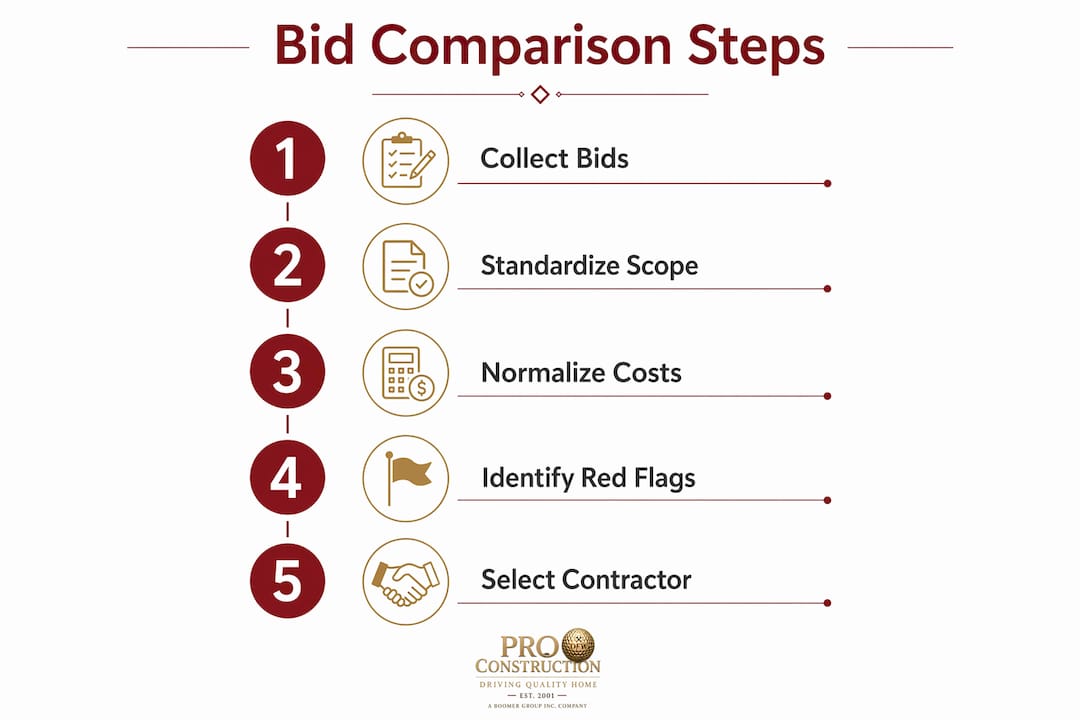
Comparing residential construction bids accurately requires detailed scope and cost normalization, not just a glance at the bottom line. A $90,000 bid and a $75,000 bid for the same project can represent identical real costs once you account for exclusions, vague allowances, and missing line items. Industry professionals call this process "bid leveling," and it is the single most reliable method for making contractor quotes comparable. Homeowners who skip it routinely face change orders that erase any savings from choosing the lower number. This guide walks you through every step of a proper residential construction bid comparison, from line-item analysis to red flags that signal a contractor you should avoid.
How to compare residential construction bids: the line items that matter
Every residential construction bid should be broken into specific categories of work and materials. When you receive proposals that list only a single lump sum or broad categories like "framing" or "finishes," you cannot make a meaningful comparison. The categories that must appear in every bid include excavation and site prep, concrete work, lumber and framing, windows and exterior doors, roofing, insulation, drywall, flooring, cabinetry, countertops, plumbing fixtures, electrical panels and rough-in, HVAC, and permits.

Pay close attention to how each contractor handles allowances. An allowance is a placeholder dollar amount for an item not yet fully specified, such as tile, light fixtures, or cabinet hardware. Allowances below market value create upfront budget gaps that contractors fill with change orders after you sign. For example, a $2,000 tile allowance for 60 square feet of backsplash underestimates mid-range subway tile by $400 to $600 before labor is even factored in.
Common exclusions that inflate a bid's apparent competitiveness include permit fees, dumpster rental, final cleaning, and door and cabinet hardware. Exclusions like permits and waste removal appear frequently in lower bids and become costly change orders later. Before you compare totals, list every exclusion from each bid and price those items separately so you are working with complete numbers.
- Scope items: Verify that excavation, concrete, framing, roofing, insulation, drywall, flooring, cabinetry, plumbing, electrical, and HVAC are all explicitly included.
- Allowances: Confirm each allowance reflects current market pricing for your area and material grade.
- Exclusions: Identify every excluded item and add a realistic cost for each before comparing totals.
- Specifications: Check that bids name specific products or grades. "Laminate flooring" is not comparable to "Shaw Floorté Pro 7mm luxury vinyl plank."
- Permits and inspections: Confirm permit fees are included. In North Texas, permit costs for a home addition can range from $800 to $3,000 depending on municipality.
Pro Tip: Ask every contractor to provide bids using the same scope document or a Work Breakdown Structure (WBS). A standardized pricing structure forces each contractor to price the exact same scope, eliminating most apples-to-oranges problems before you even open a spreadsheet.
How to normalize and level bids for a true apples-to-apples comparison
Bid leveling is the process of adjusting all proposals to reflect the same scope, so price differences reflect actual cost differences rather than scope gaps. Professional estimators use bid leveling to achieve inclusion and exclusion checks, pricing adjustments, and documented assumptions before any comparison is made. For a standard residential project, this process takes roughly one hour using a structured spreadsheet, and it consistently reveals that lower prices are offset by thousands of dollars in excluded work.
Here is how to build and use a bid leveling sheet:
- List every line item from all bids in column A. Pull items from the most detailed bid you received and add any items that appear in other bids but not that one.
- Create one column per contractor. Label each column with the contractor's name and bid date.
- Mark each line item as included, excluded, or listed as an allowance for each contractor. Use I, E, and A as shorthand.
- Add a "normalized cost" column. For any excluded item, insert a market-rate plug number. Document where that number came from, such as a supplier quote or a published cost guide, to avoid introducing bias into your comparison.
- Add a "change order risk" notes column. Flag any line item where one contractor's assumption differs significantly from the others. These are the areas most likely to generate disputes after work begins.
- Total the normalized columns. This adjusted total is your true comparison number.
Bid leveling sheet templates capture scope inclusions, exclusions, unit prices, qualifications, and schedule commitments in one place. Tools like Buildxact and construction.live offer digital templates that speed up this process, and some AI-powered tools can extract line items and flag risks automatically. For complex projects, that automation is worth the time investment.
| Column | Purpose |
|---|---|
| Line item | Names the specific scope element being priced |
| Included / Excluded / Allowance | Tracks each contractor's coverage of that item |
| Contractor A price | Raw bid amount for that line item |
| Contractor B price | Raw bid amount for comparison |
| Normalized cost | Adjusted figure after adding back exclusions |
| Change order risk | Notes on differing assumptions or vague specs |
Pro Tip: Document every plug number with its source before inserting it into your leveling sheet. Undocumented assumptions introduce bias and can lead you to favor a bid for the wrong reasons.
What red flags should you watch for when evaluating contractor bids?
A bid that comes in 30% or more below the average of your other proposals is not a deal. Bids 30% below market average signal missing scope, low-quality material assumptions, or a contractor planning to recover margin through change orders after you are committed to the project. The lowest bid wins roughly 60% of the time but is involved in disputes approximately 40% of the time, most often because of omitted scope or substituted materials.
Watch for these specific warning signs across any residential contractor quotes you receive:
- Vague or missing line items: A bid that says "kitchen renovation: $28,000" with no breakdown is impossible to evaluate and easy to exploit through change orders.
- Excessive allowances: If more than 20% of a bid's total is listed as allowances, the contractor has not done the design work needed to give you a real number.
- Large upfront deposits: Deposits above 10 to 15% of the project total before work begins are a financial risk. Reputable contractors in Texas typically request 10% to start, with draws tied to project milestones.
- No license or insurance documentation: Any contractor working in Texas must hold a valid license for their trade and carry general liability and workers' compensation insurance. Verify both before signing anything.
- Pressure to sign immediately: A contractor who insists you must sign today to lock in pricing is using a sales tactic, not giving you a business reason.
- Missing timeline or schedule: A bid without a projected start date, milestone schedule, or completion date gives you no basis for holding the contractor accountable.
"Selecting a contractor solely based on lowest total price leads to 15 to 25% higher change order costs on a $75,000 project than evaluating comparable scope bids." — Opsite for Homeowners
Contractor reputation also belongs in your evaluation. Check BuildZoom scores, Google reviews, and the Better Business Bureau. Ask for references from projects completed in the past 12 months and call them. A contractor with a strong track record and a slightly higher bid is almost always the better financial decision over a 12-month project timeline.
How many bids should you get for a residential project?
The optimal number of bids for a residential construction project is three to four. Three to four bids give you enough market data to identify pricing outliers and scope differences without overwhelming contractors or yourself. Homeowners who collect at least three bids save an average of 12 to 18% compared to those who hire the first contractor they contact, which translates to $9,000 to $13,500 on a $75,000 renovation. That is a meaningful return on the time you invest in the bidding process.
Collecting more than five bids creates two problems. First, contractors who know they are competing against four or more others often reduce the effort they put into their proposals, resulting in lower-quality bids that are harder to evaluate. Second, decision fatigue sets in for you, making it harder to apply consistent judgment across all proposals.
To get the most useful and comparable bids, follow this process:
- Prepare a detailed scope document before you contact anyone. Include floor plans, material specifications, finish grades, and any known site conditions. The more specific your request, the more comparable the responses.
- Send the same document to every contractor. Do not allow verbal scope discussions to substitute for written specifications. Verbal agreements create inconsistencies that undermine your comparison.
- Set a firm bid deadline. Give contractors two to three weeks for a standard residential project. Rushed bids produce vague numbers and missed line items.
- Communicate your evaluation criteria upfront. Tell contractors you will be comparing scope completeness, material specifications, timeline, and price. This signals that you are a serious, informed buyer and filters out contractors who rely on low-ball tactics.
Reviewing home addition contractor best practices before you send out your scope document will help you ask the right questions and set expectations that attract serious proposals.
Key takeaways
Accurate bid comparison requires normalizing scope and costs across all proposals before any price comparison is meaningful.
| Point | Details |
|---|---|
| Bid leveling is non-negotiable | Adjust all bids to the same scope before comparing totals to avoid costly surprises. |
| Allowances and exclusions distort price | Price every excluded item and verify all allowances reflect real market costs. |
| Three to four bids is the sweet spot | Fewer than three gives insufficient data; more than five reduces proposal quality. |
| 30% below average signals risk | Bids that far below market typically hide omissions or plan to recover via change orders. |
| Reputation belongs in the evaluation | A contractor's track record, license status, and insurance coverage affect real project cost. |
What 25 years of bid reviews taught me about contractor selection
After reviewing hundreds of bids across North Texas home additions and garage builds, the pattern is consistent: the homeowners who focus exclusively on the lowest number are the ones who call us mid-project after their original contractor has walked off the job or hit them with a change order that doubled the budget.
The most expensive mistake I see is treating a bid as a fixed price when it is actually a list of assumptions. A contractor who bids $68,000 on a project where two others bid $82,000 and $85,000 has not found a way to do the same work cheaper. He has priced a different project, and you will discover that difference after you have signed and paid a deposit.
What actually works is spending two hours with a spreadsheet before you make any decision. Map every line item, flag every exclusion, and call at least two references. When you do that work, the right contractor usually becomes obvious. It is rarely the cheapest and rarely the most expensive. It is the one whose bid is detailed, whose references are enthusiastic, and who can explain every number when you ask.
Transparency during the bid phase is the clearest signal of how a contractor will behave during construction. If they are vague about costs before you sign, they will be vague about change orders after.
— PRO
Why PRO Construction's bids are built for comparison
PRO Construction provides fully itemized proposals on every project, so you can place our numbers directly into your bid leveling sheet without guesswork. With over 25 years of experience in North Texas home additions and garage builds, and a top 1% ranking on BuildZoom, we build our bids to withstand scrutiny because transparent pricing is how we earn trust before a single board is cut.
Whether you are planning a room addition, a garage build, or a structural renovation, our team walks you through every line item, explains every allowance, and documents every assumption before you sign. If you are ready to compare bids with confidence, explore our home addition contractor services or request a detailed proposal directly. You will have everything you need to make a fully informed decision.
FAQ
What does it mean to level a construction bid?
Bid leveling is the process of adjusting all contractor proposals to reflect the same scope of work before comparing prices. It involves identifying inclusions, exclusions, and allowance assumptions across each bid so that price differences reflect actual cost differences rather than missing line items.
How do I know if a bid is too low?
A bid that comes in 30% or more below the average of your other proposals signals missing scope, low-quality material assumptions, or a plan to recover margin through change orders. Normal market variance across comparable bids is within plus or minus 15%.
Should I always choose the lowest residential construction bid?
No. Selecting the lowest bid without normalizing scope leads to 15 to 25% higher change order costs compared to evaluating bids on equal terms. The most accurate bid, not the cheapest one, produces the most predictable final cost.
How many contractor bids should I collect for a home project?
Three to four bids is the optimal range for a residential project. Fewer than three provides insufficient market data, while more than five reduces contractor effort and proposal quality, making comparison harder rather than easier.
What should every residential construction bid include?
Every bid should include a detailed line-item breakdown covering excavation, framing, roofing, plumbing, electrical, HVAC, finishes, and permits. It should also specify material grades, allowance amounts with clear assumptions, a project timeline, and proof of license and insurance.