

Subcontractor coordination is defined as the process of sequencing, scheduling, and managing multiple specialized trades so each one starts and finishes in the correct order on a shared job site. To coordinate subcontractors on an addition project successfully, you need three things working together: a milestone-based schedule, written agreements for every trade, and proactive permit management. Skip any one of these and you risk costly rework, trade conflicts, and weeks of unnecessary delays. This guide walks you through each step in plain language so you can manage your home addition with confidence.
How do you coordinate subcontractors on an addition project?
The most effective method to coordinate renovation teams on a home addition is scheduling trades by job readiness, not just calendar dates. Readiness-based sequencing means framing must be verified complete before rough-in trades arrive, and rough-in work must pass inspection before drywall begins. This approach prevents trade pileups, protects inspections, and eliminates the expensive rework that comes from premature starts.
A standard addition construction workflow follows this order:
- Foundation and framing — The structural shell must be complete and inspected before any trade enters.
- Rough-in plumbing — Plumbers run drain lines and supply pipes through open walls.
- Rough-in electrical — Electricians run wire and install boxes while walls are still open.
- Rough-in HVAC — Mechanical contractors install ductwork and equipment.
- Rough-in inspections — All three trades must pass before insulation is installed.
- Insulation and drywall — Only after all rough-in inspections are approved.
- Finish trades — Tile, cabinets, trim, paint, and fixture installation in sequence.
- Final inspections — Each trade receives its final sign-off before project closeout.
Treat every inspection as a fixed milestone, not a flexible date. Your entire subcontractor schedule should lock around inspection appointments because a failed inspection can push every downstream trade back by one to two weeks.
Pro Tip: Build a one-page visual sequencing map before your project starts. List each trade, its start trigger (what must be done first), and its finish line. Share it with every subcontractor at the kickoff meeting so no one claims they "didn't know" the order.

| Trade | Start Trigger | Finish Line |
|---|---|---|
| Framing | Foundation approved | Framing inspection passed |
| Rough-in plumbing | Framing inspection passed | Rough plumbing inspection passed |
| Rough-in electrical | Framing inspection passed | Rough electrical inspection passed |
| Rough-in HVAC | Framing inspection passed | Mechanical inspection passed |
| Drywall | All rough-in inspections passed | Drywall complete and taped |
| Finish trades | Drywall complete | Final inspections passed |
What should a subcontractor agreement include?
Every subcontractor on your addition project requires a separate written contract. Verbal agreements create disputes. A written subcontract agreement clearly stating scope, schedule, change order rules, insurance requirements, and lien waiver terms is the single most effective tool for reducing conflict risk on any addition project.
The industry standard form is the AIA A401 contract, which defines subcontractor responsibilities as distinct from the prime contractor-owner agreement. Using AIA A401 or a comparable written form signals professionalism and gives every party a clear reference point when disagreements arise.
Key elements every subcontractor agreement must include:
- Scope of work — A precise written description of exactly what the sub will and will not do. Vague scope is the leading cause of change order disputes.
- Schedule and milestones — Specific start dates, completion dates, and inspection milestones tied to the sequencing plan.
- Change order process — Written approval required before any work outside the original scope begins. No exceptions.
- Insurance requirements — General liability and workers' compensation certificates required before mobilization.
- Lien waiver requirements — Conditional lien waivers submitted with each pay application; unconditional waivers at final payment.
- Retainage terms — Typically 5%–10% of each payment held until final completion and inspection approval.
Pro Tip: Ask every subcontractor for a certificate of insurance before they set foot on your property. If they push back, that is a reliable sign they are not properly insured. Walk away.
| Contract Element | Why It Matters |
|---|---|
| Defined scope | Prevents "that wasn't in my bid" disputes mid-project |
| Milestone schedule | Ties payment to verified progress, not just time |
| Change order clause | Stops unauthorized work from inflating your final bill |
| Lien waiver requirement | Protects your property from mechanic's liens |
How do permits and payments affect your subcontractor schedule?
Home additions typically require four separate permits: building, electrical, plumbing, and mechanical. Permit approval timelines average 4–8 weeks for initial plan checks, plus an additional 2–4 weeks for correction cycles. That means a permit submitted late can delay your entire project start by three months. Submit all permit applications as early as possible, ideally before you finalize subcontractor contracts.
Permit coordination steps to follow:
- Submit building permit drawings with structural calculations at least 8–10 weeks before your target start date.
- Confirm that your electrical, plumbing, and mechanical subcontractors have pulled their own trade permits before mobilization.
- Schedule rough-in inspections immediately after each trade completes its work. Do not wait.
- Keep a permit log tracking submission dates, approval dates, and inspection results for every trade.
Payment coordination is equally time-sensitive. Monthly pay applications using AIA G702 and G703 forms require a schedule of values, percent-complete verification, and conditional lien waivers from each subcontractor. This documentation protects you as the homeowner and creates a clear paper trail for every dollar paid.
At project closeout, final retainage release depends on collecting unconditional lien waivers from every subcontractor. Delayed waiver collection is one of the most common reasons project closeout drags on for weeks after the work is physically complete.
Pro Tip: Create a simple payment checklist for each subcontractor: pay application received, percent complete verified, conditional lien waiver attached. Do not release payment until all three boxes are checked.
What tools and communication habits keep subcontractors on track?
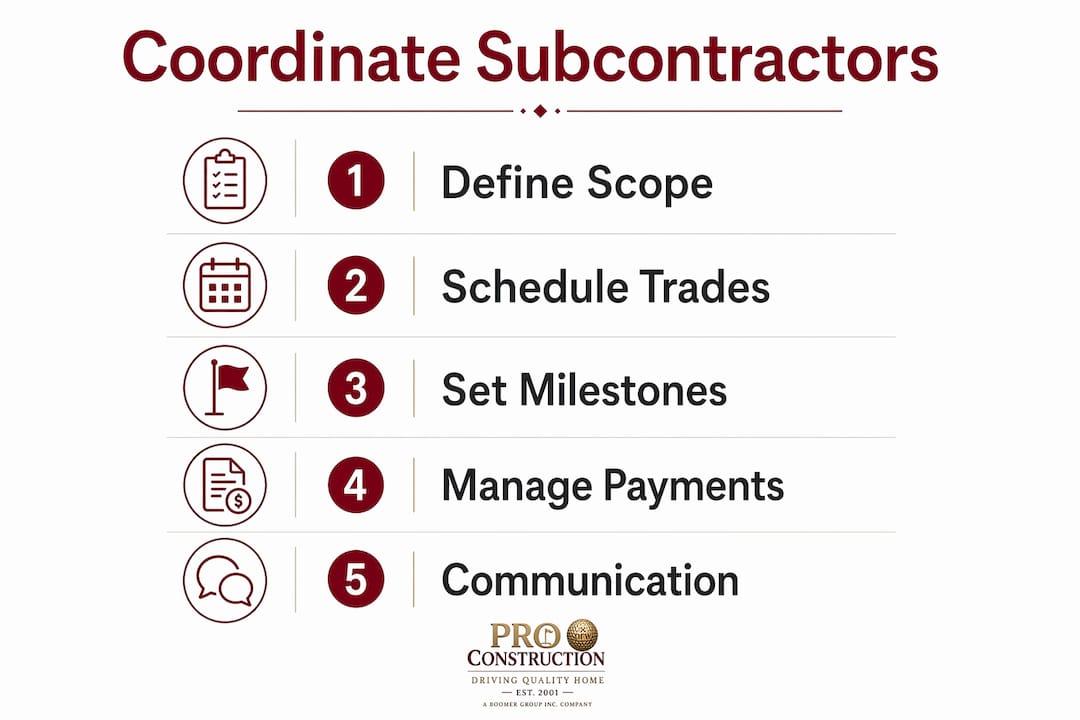
Operational cadence is the term construction managers use for the regular communication routines that keep trades aligned. Weekly look-ahead meetings and daily site verifications significantly improve schedule adherence and reduce no-shows. For a homeowner managing an addition, this translates to two practical habits: a weekly coordination call and a daily site check.
Recommended tools and practices for managing subcontractor agreements and schedules:
- Project management software — Platforms like Buildertrend, CoConstruct, or even a shared Google Sheet give every trade visibility into the current schedule and upcoming milestones.
- Written mobilization confirmations — Confirm each subcontractor's arrival in writing at least 48 hours before their scheduled start. A text message with a confirmed reply counts. A verbal phone call does not.
- Daily logs — Record crew presence, hours worked, work completed, deliveries received, and any issues encountered. Daily documentation creates proof in the event of disputes over delays or back-charges.
- Trade walk-throughs — Walk the site with each subcontractor before they start. Confirm the predecessor work is complete and the space is ready for their scope.
Pro Tip: Send a brief written summary after every coordination meeting. One paragraph, three to five bullet points, next steps assigned to specific people. This single habit eliminates more miscommunication than any software tool.
Common challenges when coordinating subcontractors on home additions
Even well-planned additions run into problems. Knowing the most common issues in advance lets you address them before they become expensive.
- Unsynchronized schedules — One trade finishes late and the next trade shows up on time anyway. The result is idle crews, wasted mobilization costs, and pressure to rush the predecessor work. Fix this by building two-day schedule buffers around every inspection milestone.
- Missing or delayed permits — A permit that is not approved when framing finishes stops every rough-in trade cold. Submit permits early and follow up weekly with your local building department.
- Poor sequencing damage — Drywall installed before plumbing inspection passes means tearing it out when the inspector requires access. Readiness-based scheduling prevents this entirely.
- Scope creep and change order disputes — Homeowners often request small changes verbally during construction. Every change, no matter how minor, must go through a written change order before work begins.
- Unforeseen conditions — Additions frequently uncover hidden structural issues, outdated wiring, or undersized plumbing behind existing walls. Budget a 10%–15% contingency above your base contract amount to absorb these discoveries without derailing the project.
Most coordination disputes evolve into payment disputes. Maintaining detailed daily logs with labor hours, work descriptions, and predecessor status is critical proof for resolving claims before they escalate.
Pro Tip: Document everything in writing from day one. Photos with timestamps, written confirmations, and daily logs cost you nothing but a few minutes each day. They can save you thousands in dispute resolution.
Key takeaways
Effective subcontractor coordination on a home addition requires readiness-based sequencing, written agreements for every trade, proactive permit management, and consistent daily documentation throughout the build.
| Point | Details |
|---|---|
| Sequence by job readiness | Schedule each trade only after the predecessor's work is verified complete and inspected. |
| Written contracts for every trade | Use AIA A401 or equivalent forms covering scope, schedule, change orders, and lien waivers. |
| Submit permits early | Plan for 4–8 weeks of permit review time and submit all applications before finalizing subcontractor start dates. |
| Confirm mobilization in writing | Send written confirmation at least 48 hours before each subcontractor's scheduled arrival. |
| Document daily | Daily logs with crew presence, work completed, and issues create the proof trail needed to resolve disputes quickly. |
What 25 years of addition projects taught me about subcontractor coordination
The single biggest mistake homeowners make is treating subcontractor coordination like a scheduling problem. It is not. It is a communication and documentation problem. Schedules slip because someone assumed something was done when it was not. Disputes escalate because no one wrote anything down. The fix is not a better app. The fix is a culture of written confirmation on every decision, every change, and every milestone.
Sequencing is where projects win or lose before a single nail is driven. At PRO Construction, we have seen additions in the Keller and Fort Worth area where a homeowner or an inexperienced contractor let a drywall crew start before rough-in inspections were approved. The result was a complete tearout and a three-week delay. That kind of rework is entirely preventable. Insisting on milestone readiness clauses in every subcontract is not bureaucratic. It is the most practical protection a homeowner has.
Contract clarity matters more than most homeowners realize. The AIA subcontractor contracting guide exists because vague agreements cost everyone money. A one-page scope definition and a clear change order clause prevent 80% of the disputes we see on addition projects.
My honest advice: if you are managing your own addition, invest two hours upfront building a sequencing map and a payment checklist. Those two documents will do more for your project than any software subscription.
— PRO
Plan your addition with a team that manages every detail
PRO Construction has spent over 25 years coordinating subcontractors on home additions across Keller, Fort Worth, and the surrounding North Texas area. We handle permit submissions, trade sequencing, written contracts, and payment documentation so you never have to chase a subcontractor or wonder what happens next.

Whether you are adding a bedroom, expanding your living space, or building out a new wing, PRO Construction brings the structure and communication your project needs. Our home addition contractors in Keller are currently offering discounts on new projects. If you are in Fort Worth, our Fort Worth addition specialists are ready to walk your site and build a detailed coordination plan. Contact PRO Construction today to get started.
FAQ
What is the correct order of subcontractors for a home addition?
The standard order is framing, then rough-in plumbing, electrical, and HVAC together, then inspections, then insulation and drywall, then finish trades. Each trade starts only after the predecessor's work passes inspection.
How far in advance should i submit permits for a home addition?
Submit all permit applications at least 8–10 weeks before your target construction start date. Plan check cycles average 4–8 weeks, with correction rounds adding another 2–4 weeks.
What is an AIA a401 contract and do i need one?
AIA A401 is the industry-standard subcontractor agreement form that defines scope, schedule, payment terms, and lien waiver requirements. Using it or a comparable written contract for every trade significantly reduces dispute risk.
How much budget contingency should i plan for a home addition?
Plan a 10%–15% contingency above your base contract amount. Additions frequently uncover hidden structural or mechanical issues behind existing walls that require additional work.
How do i prevent subcontractors from not showing up on schedule?
Confirm every subcontractor's mobilization in writing at least 48 hours before their scheduled start date. Written confirmation, not a verbal call, is the standard that reduces no-shows and unproductive wait times.