

Most homeowners assume that a valid license and a reasonable bid are enough to protect them from a bad contractor experience. They are not. Why contractor reputation matters goes far deeper than star ratings and surface-level testimonials. Reputation is a real predictor of whether your project will finish on time, stay on budget, and hold up structurally for decades. For property investors, the financial stakes are even higher. This article explains what reputation actually signals, how to read it accurately, and why skipping this step is one of the most expensive mistakes a homeowner or investor can make.
Table of Contents
- Key takeaways
- Why contractor reputation matters more than you think
- Red flags that reputation checks often miss
- How to verify contractor reputation before you commit
- The real cost of ignoring reputation
- My take on reputation as a practical risk tool
- Why PRO Construction is built on this standard
- FAQ
Key takeaways
| Point | Details |
|---|---|
| Reputation predicts project success | A contractor's track record reveals likely outcomes for budget adherence, timelines, and communication. |
| Recent reviews carry the most weight | Reviews older than three months provide little useful signal about current contractor performance. |
| Red flags go beyond star ratings | Sparse references, vague bids, and poor responses to complaints signal deeper operational problems. |
| References should be interviewed, not just listed | Ask past clients specific questions about budget, timeline, and how problems were resolved. |
| Contracts still matter | Strong reputation narrows your risk. A binding contract with clear terms closes the remaining gap. |
Why contractor reputation matters more than you think
When you hire a contractor for a home addition or major renovation, you are not just buying labor. You are buying access to their network of subcontractors, their project management habits, their relationship with suppliers, and their ability to stay financially solvent long enough to finish your job. All of those factors live inside their reputation, not inside their license number.
The importance of contractor reputation shows up clearly in consumer behavior data. 85% of consumers are more likely to hire a business after reading positive reviews, and 77% are actively deterred by negative ones. Even more telling: 93% of consumers have made purchases after reading reviews, with 27% spending over $1,000 based on that research alone. For a home addition that might cost $80,000 to $200,000, reputation is doing significant financial heavy lifting.
Here is what strong contractor trustworthiness actually signals in practice:
- Consistent communication habits. Contractors with good reputations have documented patterns of keeping clients informed, which reduces the likelihood of billing surprises or scope disagreements.
- Dispute management skills. Construction disputes cause delays, lost payments, and damaged relationships. A contractor with a strong track record has typically built internal processes that reduce how often these escalate.
- Operational stability. A consistently reviewed, actively working contractor is far less likely to be a business heading toward collapse than one with a thin or stalled review history.
- Subcontractor relationships. Reputable general contractors attract reliable subcontractors who want to protect their own reputations. The quality of a job often lives or dies on who shows up to do the actual work.
Think of reputation as the initial risk filter you apply before you ever pick up the phone. You use it to sort who is worth calling. What you do after that call determines whether you actually hire them safely.
Red flags that reputation checks often miss
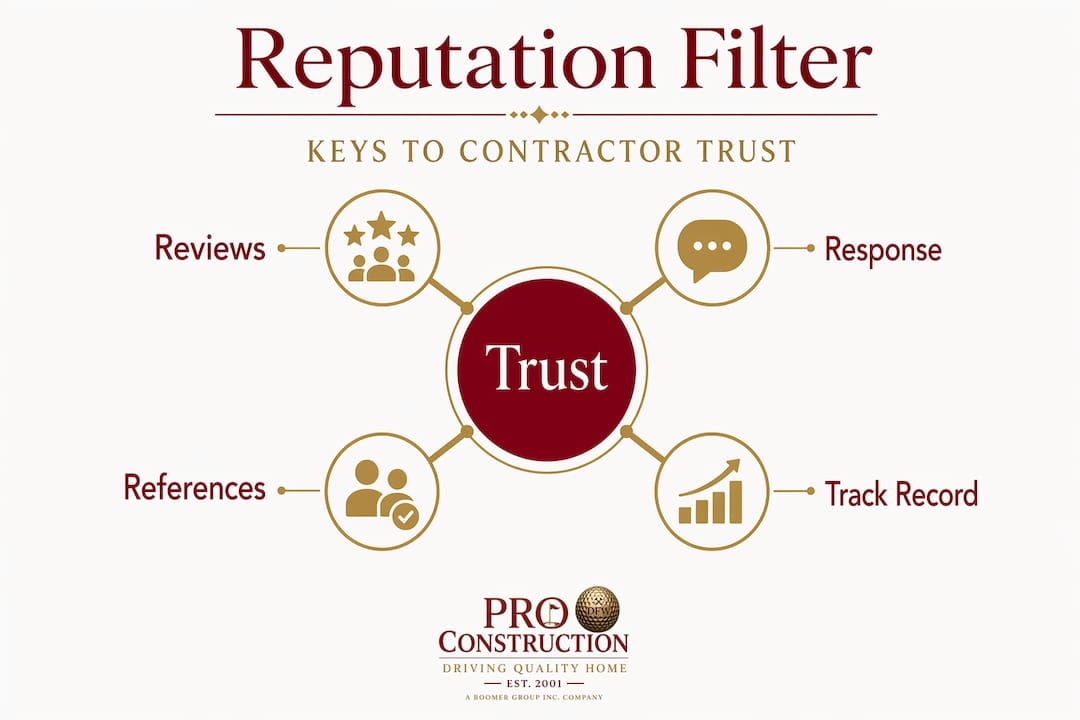
Star ratings are a starting point, not a finish line. Some of the most misleading contractor profiles look strong on the surface and only reveal their problems when you dig one layer deeper.
Outdated or sparse reviews. 74% of consumers only consider reviews from the last three months meaningful, and 47% will not use a business with fewer than 20 reviews. A contractor with a 4.8-star average from six reviews posted three years ago tells you almost nothing about how they perform today. Staff turnover, ownership changes, and financial stress can completely change a contractor's output in 18 months.
No response to negative feedback. How a contractor responds to complaints publicly reveals their accountability norms far more accurately than the complaints themselves. A contractor who posts professional, solution-oriented responses to negative reviews is signaling that they take client satisfaction seriously. One who responds defensively or not at all is giving you a preview of what a dispute would feel like from your end.
Vague or inconsistent bids. A bid that lacks itemized line items, excludes permit costs, or changes significantly between conversations is a reputation-in-progress problem. It suggests the contractor either does not have a structured process or is hiding cost exposures they expect to transfer to you later.
Watch for these additional warning signs:
- References who cannot recall specifics about the project or seem reluctant to speak at length
- Contractors who discourage you from speaking to past clients directly
- Businesses with a trail of unresolved complaints on state licensing boards or the Better Business Bureau
- Operational instability signals such as delayed callbacks, changing contact numbers, or gaps in recent project activity
Pro Tip: Search the contractor's business name along with terms like "lawsuit," "unpaid subcontractors," or "lien" in your state's court records before signing anything. This takes 10 minutes and has saved homeowners from six-figure losses.
How to verify contractor reputation before you commit
The benefits of good contractor reputation only protect you if you can accurately verify what that reputation actually reflects. Here is a structured approach that goes beyond reading Google reviews.
Step-by-step due diligence
- Filter by recency and volume. Look for contractors with at least 20 reviews, a minimum 4.5-star rating, and consistent activity within the past three months. This threshold comes directly from current consumer trust research.
- Read the contractor's responses. Sort by lowest-rated reviews and read every contractor response. Calm, professional responses to disputes indicate stronger problem-solving norms. Look for specifics, not generic apologies.
- Request three references from the past 12 months. Do not accept references older than one year. Ask those references about budget adherence, whether the timeline held, how the contractor communicated problems, and how the job site was maintained.
- Verify license and insurance independently. Cross-check the contractor's license through your state's licensing board. For Texas homeowners, a Texas contractor license check takes minutes and catches misrepresentation early.
- Assess operational health directly. Note how quickly they respond to your initial inquiry, whether their written materials are professional, and whether they can provide a clear project timeline with milestones.
Pro Tip: When you call a reference, ask this specific question: "Was there a moment when something went wrong, and how did the contractor handle it?" The answer to that one question tells you more than a glowing endorsement ever will.
Here is a quick comparison of what strong versus weak contractor reputation signals look like in practice:
| Reputation factor | Strong signal | Weak signal |
|---|---|---|
| Review recency | Multiple reviews in last 90 days | Last review is 12+ months old |
| Star rating | 4.5 stars or higher across 20+ reviews | High rating but fewer than 10 reviews |
| Negative review response | Professional, specific, solution-focused | Absent, defensive, or dismissive |
| Reference quality | Clients recall details, happy to elaborate | Clients give short, vague answers |
| Bid structure | Itemized with permit allowances included | Lump sum with no line items |
Understanding what reputable local contractors look like in each of these categories helps you make faster, more confident decisions when comparing bids.
The real cost of ignoring reputation
This is where abstract advice becomes concrete. The financial and emotional damage from hiring a contractor with poor or unverified reputation is not a worst-case scenario. It happens regularly, and the numbers are severe.
In one documented Ottawa case, a homeowner was left out $381,979 after hiring a contractor whose project management failures led to major delays, incomplete work, and substandard results. The warning signs were there in retrospect but were not caught before the contract was signed.

In a separate case in Snohomish County, a contractor shutdown left dozens of clients unpaid, with combined losses reaching $1.6 million and multiple lawsuits filed. Notably, business shutdowns are often preceded by worsening communication and delayed project activity. Those are measurable signals that a thorough reputation check would have surfaced.
| Loss scenario | Financial impact | Primary cause |
|---|---|---|
| Renovation delays, incomplete work | $381,979 | Poor project management and oversight |
| Contractor bankruptcy, abandoned projects | $1.6M+ combined losses | Operational instability not caught in vetting |
| Investor rental delay (3 months) | $9,000+ in lost rent at $3,000/month | Timeline failures from poor delivery discipline |
For property investors, the math is especially punishing. A three-month delay on a rental addition does not just inconvenience you. It eliminates months of income and can push financing deadlines past their limits. The impact of contractor reviews on decisions at the hiring stage is real precisely because the consequences of a bad hire are this severe.
"The contractor's reputation is your first contract. If it shows a history of broken commitments, no legal document will make up the difference once your project is underway."
My take on reputation as a practical risk tool
I have worked in and around the construction industry for long enough to say with confidence that reputation is the most underutilized vetting tool homeowners have. People spend more time researching a $400 appliance than they do researching a $150,000 home addition contractor. That gap costs them dearly.
What I have found is that reputation should be treated less like a recommendation and more like a track record audit. A four-star rating means nothing without context. What projects? What size? What year? I look at how a contractor describes their own past work, how their past clients describe the experience of working with them day to day, and how they respond when things go sideways. Those three filters have never steered me wrong.
The other thing worth saying: how reputation affects contractors today is changing fast. AI-driven local search results now surface and weight reviews differently than they did even two years ago. Contractors who actively manage their online reputation, respond to every review, and maintain consistent communication across platforms will increasingly dominate local visibility. That matters to you as a homeowner because it filters the playing field toward contractors who take accountability seriously.
My honest advice: treat a strong reputation as necessary but not sufficient. Pair it with a detailed contract, clear payment milestones, and your own ongoing communication during the build. Reputation earns the first conversation. Everything after that is up to you.
— PRO
Why PRO Construction is built on this standard
At PRO Construction, we have spent over 25 years in North Texas earning a reputation that holds up to exactly this level of scrutiny. Our top 1% ranking on BuildZoom is not a marketing claim. It reflects consistent delivery on budget, transparent communication from the first consultation to the final walkthrough, and a track record of completed home addition projects that clients are proud to show off. We encourage every prospective client to read our recent reviews, call our references, and ask us the hard questions before signing anything. If you are planning a home addition or garage build in the DFW area, we invite you to ask about our current homeowner discounts and request a detailed, itemized consultation. You deserve to work with a contractor whose reputation can back up every promise in the contract.
Learn more about our home additions in Keller and the surrounding area.
FAQ
Why does contractor reputation matter more than price?
Price only tells you what a project costs at the start. Reputation tells you whether that price will hold, whether the work will be completed correctly, and whether the contractor will still be in business when you need warranty work done.
How many reviews should a contractor have before I trust them?
Most consumer research points to at least 20 reviews as the minimum threshold for a credible rating, with a 4.5-star average or higher, and the majority of reviews posted within the last three months.
What questions should I ask a contractor's references?
Ask whether the project finished on budget and on time, how the contractor communicated problems, and whether there was a moment when something went wrong and how it was handled. These targeted reference questions reveal far more than a general endorsement.
Can a contractor with some negative reviews still be trustworthy?
Yes. A few negative reviews are not disqualifying. What matters is how the contractor responds to them publicly. Professional, solution-oriented responses to criticism are a strong indicator of how they handle disputes on your actual job site.
What are the biggest financial risks of hiring a contractor with a poor reputation?
Real-world cases show losses ranging from $381,979 in a single renovation failure to over $1.6 million in a contractor bankruptcy scenario. Beyond direct costs, delays can eliminate months of rental income for investors and push financing timelines past critical deadlines.