

Planning a home addition is exciting until you hit the permit question. Many homeowners assume that small projects slip under the radar, or that permits are just bureaucratic red tape that slows things down. Understanding why permits required for home additions matter goes far deeper than paperwork. Permits protect your structural safety, your legal standing, your insurance coverage, and your home's resale value. Skip them, and you risk fines, forced demolition, and a nightmare at closing. This guide breaks down what triggers permit requirements, how the process works, and how to plan smarter.
Table of Contents
- Key Takeaways
- Why permits are required for home additions
- Why permits matter beyond just following the rules
- How the home addition permit process actually works
- Common pitfalls that derail home addition permits
- How permits affect your budget and timeline
- My take: permits are not the enemy
- Let PRO Construction handle the hard part
- FAQ
Key Takeaways
| Point | Details |
|---|---|
| Permits apply to all additions | Any structural, electrical, plumbing, or mechanical work in an addition legally requires a permit under residential building codes. |
| Safety inspections catch errors early | Multiple inspection stages review work before it gets concealed in walls, preventing costly or dangerous mistakes. |
| Unpermitted work has real consequences | Skipping permits can lead to fines, forced demolition, insurance denials, and serious problems when you sell your home. |
| Permit fees are manageable | Fees typically range from $500 to $2,000, a fraction of the cost to correct unpermitted work after the fact. |
| Plan for permits from day one | Zoning approval must happen before detailed design, so build the permit process into your timeline from the start. |
Why permits are required for home additions
Under IRC Section R105.1, a building permit is required for virtually all residential construction, including additions, structural alterations, and modifications to electrical, gas, mechanical, and plumbing systems. The International Residential Code (IRC) is the model code adopted across most U.S. jurisdictions, and it draws a wide net on purpose. The goal is to make sure that any new construction meets minimum safety and structural standards before a single wall gets closed up.
The types of home additions that trigger permit requirements include:
- Bump-outs that expand an existing room's footprint
- Second-story additions adding new living space above grade
- Sunrooms and enclosed patios attached to the main structure
- Garage conversions turned into livable square footage
- In-law suites requiring plumbing, electrical, and HVAC work
There are very narrow exemptions under IRC R105.2, but they cover things like small detached accessory structures under 200 square feet or minor repairs. Home additions, by definition, do not qualify. If you are adding square footage, changing structure, or running new utilities through the new space, you need a permit. Full stop.
Pro Tip: Even minor structural repairs can require permits because their impact on overall building safety may be significant regardless of project size. When in doubt, call your local building department before starting work.
When an addition involves multiple trades, such as adding a bedroom with a bathroom and HVAC, multiple permits are required beyond just the building permit. You may need separate electrical, plumbing, and mechanical permits, each with its own plan review and inspection schedule.
Why permits matter beyond just following the rules
Permits exist because residential construction failures kill people. Faulty wiring causes house fires. Undersized beams collapse. Inadequate foundations crack and settle. The permit and inspection process is the system designed to catch these problems before they become tragedies or before they become your financial liability.
"Permits are not a hurdle to building your addition. They are the only independent verification that your addition is safe to live in."
The inspection process checks work at multiple stages: foundation and footing, rough framing, rough electrical and plumbing, insulation, and final inspection. Each stage must be approved before the next phase proceeds. This sequencing means errors get caught while correction is still affordable, not after the drywall goes up.
The legal and financial reasons are just as serious. Unpermitted additions can:
- Trigger fines from local code enforcement that compound daily
- Void homeowner's insurance coverage on the unpermitted portion of the home
- Create liability if someone is injured in the addition
- Require demolition of the entire addition at your expense
- Stall or kill a home sale when buyers' inspectors flag unpermitted work
Permits also create a permanent public record that the work was done correctly. When you sell your home, buyers and their lenders can verify that every addition was inspected and approved. That documentation protects you legally and adds confidence to the transaction.
How the home addition permit process actually works
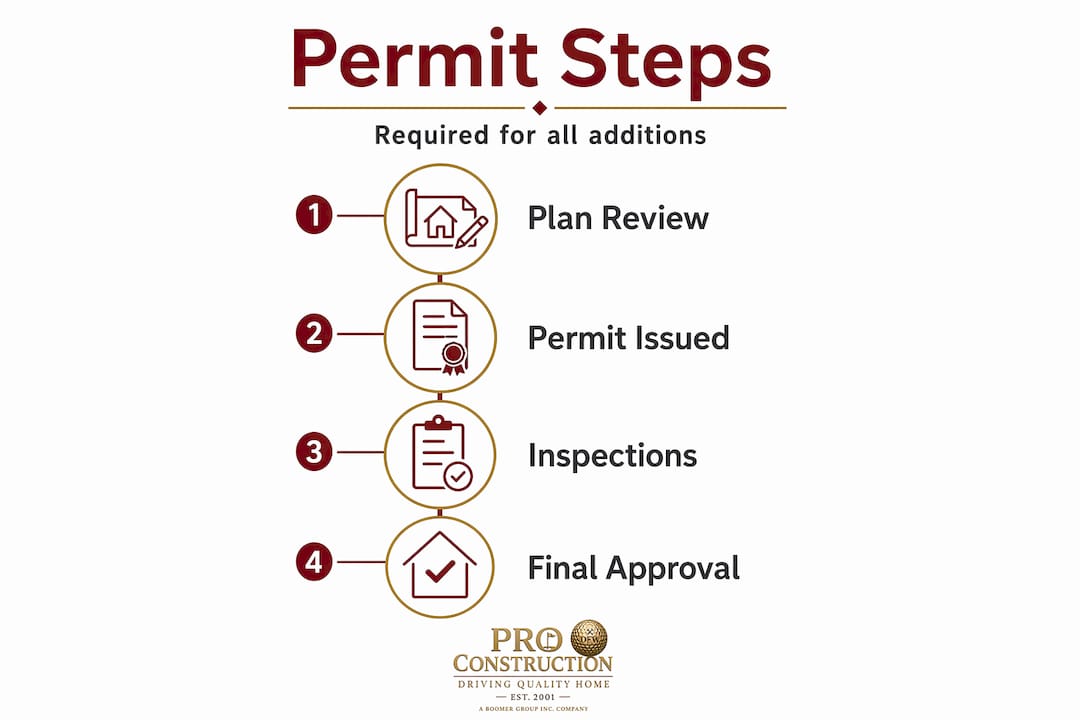
The permitting process is sequential, meaning each phase must clear before the next begins. Here is how it typically unfolds:
- Zoning review first. Before you finalize any design, confirm your lot's setbacks, height limits, and maximum lot coverage with your local zoning office. Zoning approval gates everything downstream.
- Hire a designer or architect. Most jurisdictions require stamped construction documents for additions. This includes floor plans, elevations, structural details, and site surveys.
- Submit for plan review. Applications are increasingly digital. You upload your construction documents and the building department's plan reviewers check for code compliance.
- Respond to reviewer comments. Plan reviewers almost always have questions or corrections. Prompt, complete responses prevent weeks of unnecessary delay.
- Permit issuance. Once plans are approved, your permit is issued. Keep the approved construction documents on site at all times during construction. Missing documents can stop inspections cold.
- Schedule inspections during construction. Inspections must happen at defined milestones: before concrete is poured, before walls are closed, before final occupancy.
- Final inspection and certificate of occupancy. This closes out the permit and legally authorizes use of the new space.
Pro Tip: Treat your permit inspection schedule as a hard constraint in your construction calendar, not an afterthought. Mistiming inspections causes rework that costs far more than the time saved by rushing ahead.
If your addition involves multiple trades, coordinate the inspection schedule across all permits. Electrical rough-in must be inspected before framing is closed. Plumbing rough-in must clear before concrete floors are poured. These sequences are not flexible.

Common pitfalls that derail home addition permits
Most permit problems are predictable. Knowing them in advance saves you weeks and thousands of dollars.
The biggest mistake is assuming a small addition does not need a permit. Exemptions under the IRC are specific and narrow. "Small" is not a category. If you are adding square footage or modifying structure, you need a permit regardless of how modest the scope feels.
Incomplete or incorrect documents are the second most common problem. Submitting wrong permit types or incomplete plans puts you in a review queue that resets every time you resubmit. Every delay costs schedule time and often money in contractor standby.
Here is a practical comparison of permitted versus unpermitted work outcomes:
| Scenario | Permitted Addition | Unpermitted Addition |
|---|---|---|
| Construction safety | Inspected at each stage | No independent verification |
| Insurance coverage | Fully covered | Likely voided on that portion |
| Resale impact | Clean title and records | Buyers may demand demolition or price reduction |
| Enforcement risk | None | Fines, stop-work orders, forced removal |
| Long-term liability | Reduced | Owner assumes full risk |
Zoning violations are another costly trap. Ignoring setback or lot coverage rules can force you to tear down a completed addition at your own expense. Confirm zoning compliance before you spend a dollar on design.
On the contractor side, licensed contractors are typically required to pull trade permits. Owner-builder permits exist in many jurisdictions, but they transfer full liability to the homeowner and can complicate resale. Hiring licensed, experienced contractors who understand the local permitting process is one of the best protections available to you. Check out these signs of a reliable contractor before you commit to anyone.
How permits affect your budget and timeline
Permit fees for home additions typically range from $500 to $2,000 depending on project scope, jurisdiction, and valuation method. On a $100,000 addition, that is 0.5% to 2% of your total budget. The cost of correcting unpermitted work can dwarf that number many times over, especially if a buyer demands demolition or a lender requires compliance documentation.
Practical ways to budget and plan smarter:
- Add permit timelines to your schedule from day one. Plan review can take two to eight weeks depending on your jurisdiction and workload. Do not schedule your contractor start date before permit issuance.
- Hire professionals with local code knowledge. Architects and designers familiar with your jurisdiction's requirements dramatically reduce the back-and-forth during plan review.
- Budget for all permits, not just the building permit. Electrical, plumbing, mechanical, and gas permits each have separate fees. Get a full estimate upfront.
- Factor in inspection hold points. Construction must stop at defined milestones to wait for inspectors. Build these holds into your schedule so they do not feel like surprises.
The permit process is an investment in transparency. Every inspection record, every approved plan, every certificate of occupancy becomes documentation that your addition was built to code. That record pays dividends at every future life event: refinancing, selling, or filing an insurance claim.
My take: permits are not the enemy
I have worked on home additions for over 25 years in North Texas, and the homeowners who struggle most with permits are almost always the ones who waited too long to think about them. They lock in a design, commit to a contractor, and then discover that the setback rules make their planned addition illegal as drawn. Starting over at the design phase costs real money.
What I have learned is that the permit process, handled correctly, actually makes your addition better. Independent plan reviewers catch things that even experienced contractors miss. Inspection hold points force a rhythm onto construction that reduces errors. The documentation trail protects you in ways you will not fully appreciate until you try to sell the house or file an insurance claim after a storm.
The homeowners who come to me frustrated by permits are usually reacting to a bad experience with a contractor who did not manage the process well. When permitting is integrated into project management from day one, it is not friction. It is structure. And structure is what turns a stressful renovation into a project that finishes on time, on budget, and to code.
If you are weighing whether to pull permits on your next addition, the answer is always yes. The consequences of skipping them are not theoretical. They are documented, enforceable, and expensive.
— PRO
Let PRO Construction handle the hard part

Permitting for a home addition in North Texas involves zoning reviews, multiple trade permits, sequenced inspections, and documentation that has to stay current through the entire build. Getting it wrong costs time, money, and stress. PRO Construction has managed this process for over 25 years across Keller, Fort Worth, and the surrounding North TX area. Our team knows local codes, maintains relationships with building departments, and coordinates all permits as part of your project management, not as an add-on.
Whether you are planning a room addition, a second story, or a garage conversion, our home addition contractors are ready to walk you through the permitting process and build your addition right the first time. Ask about our current homeowner discounts when you contact us for a consultation.
FAQ
Do I need a permit for every type of home addition?
Yes. Under IRC R105.1, any addition that expands your home's structure, living space, or utility systems requires a building permit. Very limited exemptions apply only to small detached structures and minor repairs, not to additions.
What happens if I build an addition without a permit?
Unpermitted additions can result in fines, stop-work orders, and forced demolition. They also create insurance coverage gaps, complicate home sales, and expose you to personal liability if someone is injured in the unpermitted space.
How long does the home addition permit process take?
Plan review alone can take two to eight weeks depending on your jurisdiction. Factor in design, zoning review, permit issuance, and inspection scheduling, and you should plan for the permitting process to take one to three months before construction can begin.
Who pulls the permits for a home addition?
In most jurisdictions, licensed contractors pull trade permits such as electrical, plumbing, and mechanical. Homeowners can pull permits as owner-builders in many areas, but doing so transfers full liability to the homeowner and can complicate future resale.
How much do home addition permits cost?
Permit fees typically range from $500 to $2,000 for most residential additions, though complex projects in higher-cost jurisdictions can run higher. That cost is minor compared to the fines and correction costs that come with unpermitted construction.