

Hiring a local contractor is the most direct path to cost savings on home renovations, with local builders typically charging 30–50% less than national brands for comparable work. The role of local contractor cost savings goes beyond simple price differences. It comes from structural advantages: no franchise royalties, no national advertising budgets, and supplier relationships built over years in your specific market. For homeowners planning additions, garage builds, or major renovations, understanding these drivers is the difference between a project that stays on budget and one that doesn't.
What factors drive local contractor cost savings?
Local contractors carry a fundamentally different cost structure than national firms, and that difference flows directly to your bottom line. National brands price projects 100–139% above local competitors for comparable materials and installation. That gap exists because national companies pass franchise royalties, regional management overhead, and brand marketing expenses onto every customer invoice.
Local builders avoid all of that. Their pricing reflects actual regional labor rates, real supplier costs, and the specific conditions of your local market. This is what makes cost efficiency with local builders a structural advantage, not just a negotiating tactic.
Here are the primary cost drivers that give local contractors their pricing edge:
- Lower overhead structure. Local contractors operate without franchise fees or national advertising costs, which allows them to price projects closer to actual cost. This is the single largest factor separating local bids from national quotes.
- Established supplier networks. Years of repeat business with regional suppliers and material yards translate into preferred pricing that national firms cannot access at the local level. Those savings pass directly to your project budget.
- Pre-vetted local labor. 91% of North American construction firms report that access to skilled labor is the top factor controlling costs and timelines. Local contractors maintain relationships with trusted tradespeople who show up on schedule and work efficiently, reducing the costly delays that inflate final bills.
- Accurate local market knowledge. A contractor who has built in your area for years knows what materials cost, how long permits take, and where supply chain gaps exist. That knowledge produces tighter, more realistic bids with fewer surprise line items.
- Bundled service discounts. Local contractors minimize travel costs and often offer bundled pricing when multiple trades or services are combined, increasing affordability for larger renovation scopes.
Pro Tip: Before signing any contract, ask your local contractor to name their primary material suppliers and two or three subcontractors they use regularly. A contractor with established local relationships will answer that question immediately. One who hesitates likely lacks the network that produces real cost savings.
How does local expertise reduce unexpected costs and delays?
Budget overruns rarely come from the original scope. They come from surprises: a permit that takes three weeks longer than expected, a zoning variance nobody anticipated, or a material substitution required mid-project because the original spec doesn't meet local code. Local contractors eliminate most of those surprises before they become line items.

Knowledge of local zoning laws and building codes allows local contractors to avoid costly regulatory delays and rework. A contractor who has pulled permits in your municipality dozens of times knows the inspector's expectations, the common rejection triggers, and the fastest path to approval. That experience has a real dollar value.
Ignoring local market conditions can cause a 5–8% unexpected cost variance in any given project. On a $150,000 home addition, that translates to $7,500 to $12,000 in unplanned expenses. Local contractors size their contingency reserves based on actual regional conditions rather than generic national benchmarks, which means their budgets hold up better when reality diverges from the plan.
The accountability factor matters here too. Consider what drives a local contractor's business model:
- Their next five projects will likely come from referrals in your neighborhood.
- Their reputation in the community is their primary marketing channel.
- A cost overrun or a failed inspection reflects directly on their name, not a corporate brand.
That reputation dependence creates a financial incentive for transparency that national firms simply do not have. Local builders prioritize transparent communication about costs, which helps homeowners make informed decisions without pressure or surprise invoices at project close.
"Local expertise enables contractors to size more accurate contingency reserves, controlling project risk better than generic national benchmarks." — Conseco Group on local market economics
Local vs. national builders: what do homeowners actually save?
The base price on a national builder's quote often looks competitive. The final invoice rarely does. National builders frequently increase total project costs through design center upsells, while local contractors provide itemized quotes with fewer hidden fees. That distinction matters enormously when you are managing a fixed renovation budget.
Mid-sized regional builders offer more accurate pricing based on real regional costs, which reduces financial surprises after you have already signed a contract. National firms use standardized pricing models built on national averages, which can be significantly off from what labor and materials actually cost in your specific zip code.
The table below summarizes the key differences homeowners should weigh when comparing local and national contracting options.
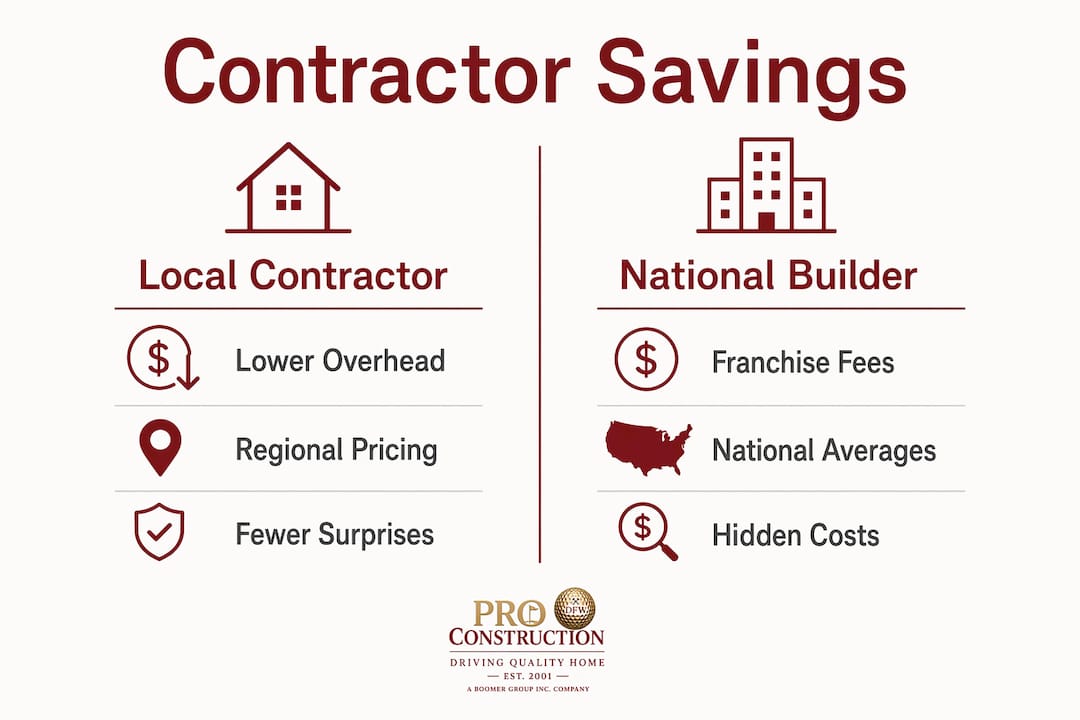
| Factor | Local contractor | National builder |
|---|---|---|
| Overhead structure | No franchise fees or national marketing costs | Franchise royalties and brand advertising built into pricing |
| Quote transparency | Itemized bids with clear scope and contingencies | Bundled pricing with design center upsells common |
| Pricing accuracy | Based on real regional labor and material costs | Standardized national averages, often misaligned locally |
| Regulatory knowledge | Deep familiarity with local codes and inspectors | Generalized compliance approach, higher variance risk |
| Accountability model | Reputation-driven, community-based referrals | Corporate brand insulation from individual project outcomes |
| Cost premium vs. local | Baseline | 100–139% above local for comparable work |
The advantages of local contracting become most visible in the final reconciliation. When a local contractor gives you a number, that number is grounded in what things actually cost in your area. When a national firm gives you a number, it is grounded in what things cost on average across dozens of markets, plus the margin required to support a national infrastructure.
For homeowners in North Texas, the local contractor benefits documented across regional markets consistently show the same pattern: lower base costs, fewer change orders, and more predictable final invoices.
What steps maximize your savings with local contractors?
Choosing a local contractor is the right starting point. Getting the most out of that choice requires a few deliberate steps before and during the project.
- Verify licenses and certifications first. For any renovation on a home built before 1978, confirm that your contractor holds EPA RRP certification. This certification signals regulatory compliance and prevents costly fines or project shutdowns that can derail your budget entirely.
- Request detailed, itemized bids. A quality bid breaks down labor, materials, permits, and contingency separately. Any contractor who provides a single lump-sum number without line items is hiding flexibility that will cost you later. Ask for scope clarity in writing before signing anything.
- Engage the contractor early in the design phase. Local contractors who participate in design decisions can flag cost-saving material substitutions, identify scope elements that drive disproportionate cost, and sequence work to reduce labor overlap. Early collaboration consistently produces better budgets than bringing a contractor in after all decisions are made.
- Track every change order in writing. Verbal approvals for scope changes are the most common source of budget overruns on residential projects. Require written change orders with cost impact stated before any out-of-scope work begins.
- Check references from recent local projects. Ask specifically whether the final invoice matched the original bid and whether the project finished on schedule. Those two questions reveal more about a contractor's cost management than any credential.
Pro Tip: When comparing bids from multiple local contractors, look at the contingency line specifically. A contractor who includes a realistic 10–15% contingency is being honest about project risk. One who shows zero contingency is either inexperienced or building that buffer into other line items where you cannot see it.
You can also review contractor specialization factors to understand how a contractor's regional trade relationships directly affect your material and labor costs before you commit to a bid.
Key takeaways
Local contractors deliver measurable cost savings through lower overhead, regional supplier networks, and local market expertise that national firms cannot replicate at the project level.
| Point | Details |
|---|---|
| Structural cost advantage | Local contractors charge 30–50% less by eliminating franchise fees and national marketing overhead. |
| Local expertise prevents overruns | Familiarity with local codes and inspectors reduces the 5–8% unexpected cost variance common in poorly planned projects. |
| Transparent pricing model | Itemized local bids with realistic contingencies produce fewer financial surprises than national builder quotes. |
| Labor reliability controls budgets | Pre-vetted local tradespeople reduce delays and cost overruns that inflate final project costs. |
| Verification protects savings | Confirming EPA RRP certification, checking references, and requiring written change orders locks in the savings a local contractor offers. |
What 25 years in North Texas taught me about local contractor value
The homeowners who get the best outcomes are not always the ones with the biggest budgets. They are the ones who understand what they are actually buying when they hire locally. After 25 years of building additions and garages across North Texas, I can tell you that the cost savings are real, but they are not automatic. They require a contractor who is genuinely embedded in the local market, not just one who happens to have a local address.
What most articles miss is the compounding effect of local knowledge. It is not just that we know the permit office. It is that we know which inspectors are strict about specific code items, which material suppliers have reliable stock in a given season, and which subcontractors will show up on a Tuesday in July when temperatures hit 105 degrees. That knowledge prevents the small delays and substitutions that quietly add 8–12% to a project's final cost.
The transparency point is also undervalued. A local contractor's next job depends on the homeowner they are working for right now recommending them to a neighbor. That dynamic changes how we price, how we communicate, and how we handle the inevitable surprises that come with any renovation. We do not have a corporate escalation path. We have a reputation. That is a more powerful accountability mechanism than any contract clause.
My honest advice: do not evaluate local contractors on base price alone. Evaluate them on how clearly they explain their bid, how specifically they answer questions about local code and supplier relationships, and how recent their references are. Those signals tell you whether the cost savings will actually materialize or just look good on paper.
— PRO
How PRO Construction delivers affordable home additions in North Texas
PRO Construction has served North Texas homeowners for over 25 years, holding a top 1% ranking on BuildZoom and specializing in home additions and garage builds that stay on budget. The company's transparent pricing model, established regional supplier relationships, and deep familiarity with North Texas permitting processes reflect exactly the local contractor advantages this article describes.

If you are planning a home addition or renovation in the Keller or Fort Worth area, PRO Construction provides detailed, itemized bids with no hidden fees and a project management process designed to keep you informed at every stage. Explore home addition services in Keller, TX to see current pricing, available discounts, and how PRO Construction's local expertise translates directly into cost certainty for your project.
FAQ
How much can homeowners save by hiring a local contractor?
Local contractors typically charge 30–50% less than national brands for comparable projects. National firms price work 100–139% above local competitors due to franchise fees and marketing overhead built into every quote.
Why do local contractors offer more accurate bids than national builders?
Local contractors base their pricing on real regional labor and material costs rather than national averages. Mid-sized regional builders provide itemized quotes with fewer hidden fees, which reduces financial surprises after signing.
What credentials should I verify before hiring a local contractor?
Confirm a valid state contractor license and, for homes built before 1978, EPA RRP certification. These credentials prevent costly fines, project shutdowns, and rework that can eliminate any savings from hiring locally.
How does local market knowledge prevent budget overruns?
Ignoring local market conditions causes a 5–8% unexpected cost variance in projects. Local contractors with permit and inspection experience size contingency reserves accurately, keeping budgets aligned with actual project conditions.
What is the best way to compare local contractor bids?
Request fully itemized bids that separate labor, materials, permits, and contingency. Check whether the contingency line is realistic at 10–15%, and ask references specifically whether the final invoice matched the original bid.