

A licensed contractor is a construction professional authorized by a state or local licensing authority after passing exams, demonstrating field experience, and agreeing to comply with local building codes. The term "licensed contractor" is the standard industry phrase used by state licensing boards, courts, and insurance carriers. Understanding what this credential actually covers protects you from costly mistakes before a single nail is driven. States like Florida, Texas, and California each define licensing requirements differently, and those differences directly affect your legal rights as a homeowner. This article breaks down the licensed contractor definition, how to verify one, and what the credential actually guarantees.
What does "licensed contractor" mean in construction?
A licensed contractor is not simply someone who has filed paperwork. Licensing represents a formal determination by a government authority that a contractor has met minimum competency standards for a specific trade or scope of work.
Requirements differ by location and trade. Texas does not require a state license for general contractors, but electricians and plumbers must hold state-issued licenses. California requires a license from the Contractors State License Board (CSLB) for any project valued over $500. Florida issues trade licenses through the Department of Business and Professional Regulation (DBPR), covering categories like general contractor, roofing contractor, and electrical contractor.

The license itself is tied to a specific classification. A roofing license does not authorize electrical work. A general contractor license in one state may not transfer to another. This classification system exists to match verified competency to the actual work being performed, which is why the licensed contractor meaning in construction goes well beyond a single credential.
Pro Tip: Ask any contractor for their license number before discussing your project. Run that number through your state's official licensing board website to confirm the classification covers your specific job.
What requirements must be met to become a licensed contractor?
Becoming a licensed contractor requires meeting a combination of experience, education, and examination standards that vary by state and trade. Here is what the process typically involves:
- Field experience: Most states require two to five years of documented work experience in the relevant trade before an applicant can sit for the licensing exam.
- Written examination: Applicants must pass a trade-specific exam covering building codes, safety standards, and business practices. California's CSLB administers separate exams for each of its license classifications.
- Financial documentation: Many states require proof of financial solvency, a surety bond, and general liability insurance as part of the application.
- Background check: Criminal history reviews are standard in states like Florida and California.
- License renewal: Licenses are not permanent. Most states require renewal every one to two years, along with continuing education credits to maintain active status.
Texas presents an interesting case study in how to become a licensed contractor. The state does not license general contractors at the state level, but it does require licenses for specific trades. A Texas electrician must hold a license from the Texas Department of Licensing and Regulation (TDLR), while a plumber must be licensed through the Texas State Board of Plumbing Examiners. This means a homeowner in Texas must verify trade-specific licenses rather than relying on a single general contractor credential.
Pro Tip: License renewal dates matter as much as the original credential. A license that expired six months ago offers you zero legal protection. Always check the expiration date, not just the active status.
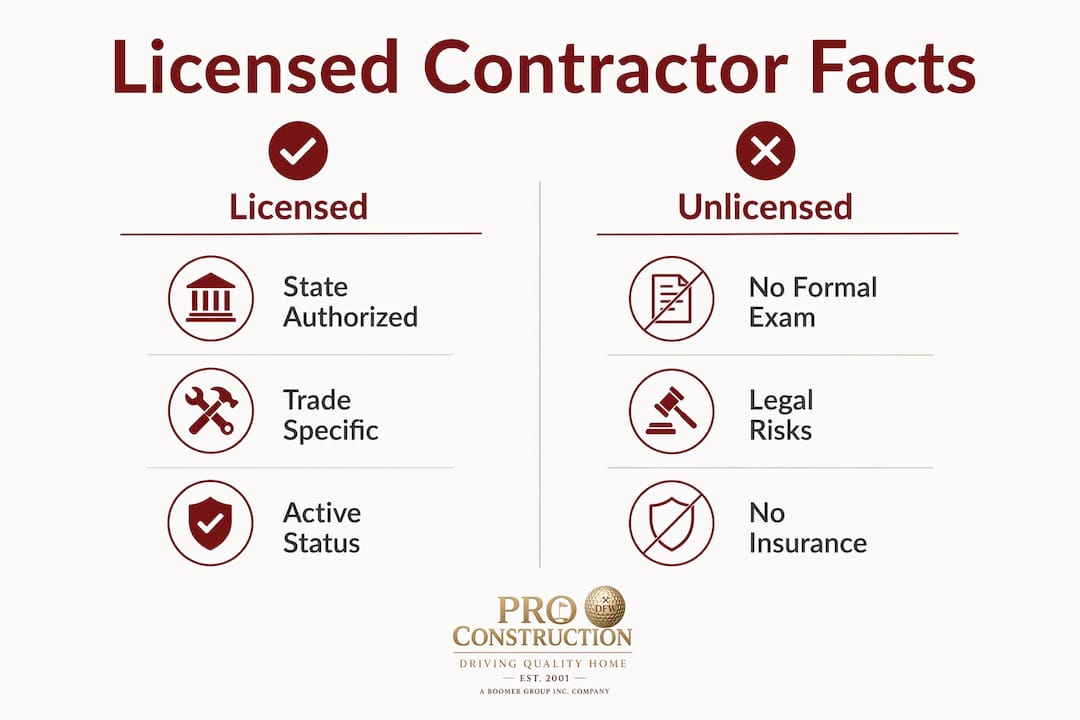
Licensed contractor vs unlicensed: what are the real risks?
Hiring an unlicensed contractor is not just a quality gamble. It is a legal and financial exposure that can follow you for years after the project ends.
Here is what you actually risk when you skip the license check:
- Loss of contract enforceability. California Business and Professions Code §7031 prohibits unlicensed contractors from suing for payment and allows homeowners to recover all compensation paid, even if the homeowner knew the contractor was unlicensed. The recovery window is two years.
- Code violations and failed inspections. Unlicensed contractors have not demonstrated required competency and pose direct risks for substandard work or building code violations. Failed inspections can halt a project and require expensive remediation.
- No insurance coverage. Most general liability and workers' compensation policies are issued to licensed contractors. If an unlicensed worker is injured on your property, you may be personally liable.
- Permit problems. Many jurisdictions only issue building permits to licensed contractors. Work done without a permit can complicate a future home sale or refinance.
"Licensed contractors have passed experience and exam requirements and agreed to comply with local building codes, providing quality assurances homeowners can trust. Unlicensed contractors have not demonstrated required competence and pose risks for substandard work or code violations." — Augusta Free Press
The consequences of unlicensed contracting vary by jurisdiction, but penalties for the contractor can include fines, criminal charges, and permanent license denial. For the homeowner, the consequences are financial and structural. The benefits of licensed residential contractors extend well beyond paperwork. They include enforceable contracts, code-compliant work, and a clear path for dispute resolution.
How can homeowners verify a contractor's license?
Verification takes less than ten minutes and can save you from a six-figure mistake. Here is the process:
- Use your state's official licensing board portal. California homeowners use the CSLB license check at cslb.ca.gov. Florida homeowners use the DBPR online verification tool. Texas homeowners can check trade-specific licenses through TDLR or the Texas State Board of Plumbing Examiners.
- Confirm the license is active. An expired or suspended license provides no legal protection. Most state boards display license status, classification, bond info, insurance, expiration date, and disciplinary history in their public lookup tools.
- Match the classification to your project. Even if a contractor claims to be licensed, if the license classification does not cover the specific trade, the contractor is effectively unlicensed for that work. A general contractor license does not cover electrical or plumbing work in most states.
- Verify the name matches. The license must be held by the individual or business entity you are contracting with. A subcontractor's license does not cover the general contractor you hired.
- Request a Certificate of Insurance (COI). A COI confirms general liability and workers' compensation coverage. However, COIs can lapse or may not cover the full scope, so confirm current coverage directly with the insurer.
| Verification step | What to check | Where to check |
|---|---|---|
| License status | Active, not expired or suspended | State licensing board portal |
| License classification | Matches your specific project type | State board license detail page |
| Name match | Individual or business name on contract | State board record vs. your contract |
| Insurance coverage | General liability and workers' comp | Request COI, then call insurer directly |
| Disciplinary history | No unresolved complaints or violations | State board public record |
For Texas homeowners specifically, the Texas contractor license verification guide walks through each state agency and what to look for in 2026. For roofing projects specifically, understanding roofing contractor qualifications adds another layer of protection.
Pro Tip: Always ask contractors for their license number and verify the classification matches the specific work required. Generic "licensed" statements on a website or business card are not verification.
What does "licensed and insured" actually mean for your project?
"Licensed and insured" is one of the most misused phrases in the construction industry. It sounds like a complete credential, but it bundles three separate things that must each be verified independently.
Here is what the phrase actually contains:
- State trade license: Issued by a state licensing authority like Florida's DBPR or California's CSLB. This confirms the contractor has met competency requirements for a specific trade. The trade license is held by a named individual called the "qualifier" and defines the authorized scope of work.
- Local business tax receipt: A local permit confirming the business can legally operate in a specific municipality. This is not a trade license and does not confirm any competency.
- Certificate of Insurance (COI): Documents that general liability and workers' compensation insurance are in place. Contractors often confuse COIs with licenses, but COIs only prove insurance coverage. Licenses attest to legal authorization and competency.
| Credential | What it confirms | What it does NOT confirm |
|---|---|---|
| State trade license | Competency, legal authorization for specific trade | Insurance coverage or local business registration |
| Local business tax receipt | Right to operate locally | Trade competency or insurance |
| Certificate of Insurance | Active insurance policy at time of issuance | License status or ongoing coverage |
The biggest misconception in Florida is equating "licensed and insured" with holding a proper DBPR trade license. In Florida, this phrase often mixes DBPR trade licenses, local business tax receipts, and insurance certificates, which are distinct credentials. A contractor can hand you a COI and a business tax receipt without holding a single state trade license. Certificates of insurance can become invalid or lapse without the homeowner knowing, making direct insurer confirmation the safest verification method.
Understanding contractor specialization and license classifications helps you ask the right questions before signing anything.
Key takeaways
A licensed contractor is a state-authorized professional whose license classification, active status, and insurance coverage must each be verified separately before any construction work begins.
| Point | Details |
|---|---|
| Licensing is trade-specific | A general contractor license does not cover electrical or plumbing work in most states. |
| Verification requires official tools | Use state board portals like CSLB, DBPR, or TDLR to confirm active status and classification. |
| "Licensed and insured" is not one credential | State trade license, local business permit, and COI are three separate documents requiring separate checks. |
| Unlicensed work carries legal risk | California §7031 allows homeowners to recover all payments made to unlicensed contractors. |
| COIs can lapse without notice | Confirm insurance directly with the insurer, not just from the document the contractor provides. |
Why I tell every homeowner to verify before they trust
After 25 years of building in North Texas, I have seen the same scenario play out more times than I can count. A homeowner hires someone based on a referral and a handshake. The contractor shows up with a business card that says "licensed and insured." The work starts. Then something goes wrong, and the homeowner discovers the license expired two years ago or covers a completely different trade.
The uncomfortable truth is that most homeowners never verify. They assume the contractor would not lie, or they feel awkward asking for documentation. That discomfort costs people real money. I have spoken with homeowners who paid tens of thousands of dollars for work that failed inspection, could not be permitted, or had to be torn out entirely.
My practical advice goes beyond the standard checklist. When you receive a COI, call the insurance company directly and ask if the policy is current and covers the scope of your project. When you pull up a license on a state board portal, read the disciplinary history section, not just the status field. A license can be technically active while carrying unresolved complaints.
Licensing is not a bureaucratic formality. It is the single most reliable signal that a contractor has been tested, vetted, and held accountable by a government authority. The qualities that define reputable local contractors always start with that foundation. Everything else, quality, communication, timelines, builds on top of it.
— PRO
Work with a licensed contractor you can verify

PRO Construction holds all required licenses and insurance for residential construction in North Texas, with over 25 years of active project experience and a top 1% ranking on BuildZoom. Every project is managed by a licensed professional whose credentials you can verify through the appropriate state board before signing a contract. If you are planning a home addition, garage build, or structural renovation, you deserve a contractor whose license classification actually matches the work being done. Explore PRO Construction's home addition services in Keller, TX or contact the team directly to confirm credentials and get a project estimate with full transparency from day one.
FAQ
What is the licensed contractor definition?
A licensed contractor is a construction professional authorized by a state or local licensing authority after meeting minimum requirements, including passing trade exams and demonstrating documented field experience. The license is tied to a specific trade classification and must remain active to be valid.
How do I verify a contractor's license in Texas?
Texas does not issue a single state license for general contractors, so verification depends on the trade. Use the Texas Department of Licensing and Regulation (TDLR) portal for electricians and HVAC technicians, and the Texas State Board of Plumbing Examiners for plumbers. Confirm the license is active and the classification matches your project.
What is the difference between licensed contractor vs unlicensed?
A licensed contractor has passed state-required exams, met experience thresholds, and agreed to comply with building codes. An unlicensed contractor has not met those standards, which means their work may fail inspection, void your insurance, and leave you without legal recourse if something goes wrong.
Does "licensed and insured" mean a contractor is fully qualified?
Not automatically. "Licensed and insured" combines three separate credentials: a state trade license, a local business tax receipt, and a Certificate of Insurance. Each must be verified independently, since a contractor can hold a business permit and a COI without holding a valid state trade license.
Can a homeowner recover money paid to an unlicensed contractor?
In California, yes. California Business and Professions Code §7031 allows homeowners to recover all compensation paid to an unlicensed contractor, with a two-year statute of limitations. This applies even if the homeowner was aware the contractor lacked a license at the time of hiring.