

General contractors are the professionals who manage every moving part of a construction project, from pulling permits to coordinating plumbers, electricians, and framers under one roof. They serve as your single point of accountability for budget, timeline, and quality. Hiring the wrong one costs far more than the price difference between bids. This guide gives you the exact criteria to verify credentials, read bids, manage payments, and communicate effectively so your renovation or home addition finishes on time and on budget.
What credentials should you verify when hiring general contractors?
Skipping license and insurance verification is one of the costliest mistakes homeowners make when hiring a contractor. A license proves the contractor has met your state's minimum competency standards. Insurance protects you from financial liability if a worker is injured on your property or if the work damages a neighboring structure.
Here is what to verify before signing anything:
- State license: Check your contractor's license number directly with your state licensing board. Texas homeowners can follow a step-by-step process to verify a contractor's license and confirm it is active and in good standing.
- General liability insurance: The recommended minimum coverage is $1 million in general liability plus workers' compensation. That threshold covers most residential project risks.
- Workers' compensation: This coverage pays for medical costs if a laborer is hurt on your job. Without it, you could be held liable.
- Bonding: A surety bond is financial protection if the contractor abandons the project or fails to pay subcontractors. It is separate from insurance and equally worth confirming.
- Certificate of Insurance: Always request a current Certificate of Insurance directly from the contractor's insurer, not just a photocopy. Call the insurer to confirm the policy is active.
Understanding why contractor insurance matters is not just paperwork. It is the difference between a protected project and a financial disaster.
Pro Tip: Ask the contractor to name you as an additional insured on their policy for the duration of the project. This gives you direct standing to file a claim if something goes wrong.
How do you compare and evaluate bids effectively?
A bid is not just a number. It is a window into how a contractor thinks, plans, and communicates. The structure of a bid tells you as much as the price itself.

Request at least three detailed written bids that break down costs by category. A legitimate bid separates materials, labor, permits, and markup. A lump-sum number with no line items is a red flag. You cannot compare two bids accurately if one says "$45,000 total" and another itemizes every phase of work.
Follow these steps to evaluate bids properly:
- Define your project scope first. Defining scope before your first call helps every contractor quote the same project. Without a clear scope, you are comparing apples to oranges.
- Review line items side by side. Create a simple spreadsheet. List materials, labor, permits, and markup across all three bids. Gaps in one bid often mean those costs appear later as change orders.
- Ask about allowances. Allowances are placeholders for items not yet selected, like tile or fixtures. Low allowances inflate the gap between the bid price and the final invoice.
- Visit active job sites. Ask each contractor for a current project you can walk through. You will see how they manage crews, cleanliness, and material storage.
- Check references from the last 12 months. Contact at least three recent references and look for patterns in online reviews on Google, Yelp, the Better Business Bureau, and Houzz.
| Bid Element | What to Look For | Red Flag |
|---|---|---|
| Cost breakdown | Labor, materials, permits, markup listed separately | Lump-sum total only |
| Allowances | Realistic amounts based on current material costs | Unusually low allowances |
| Timeline | Start date, milestones, completion date | No schedule provided |
| Exclusions | Clearly listed items not covered | No exclusions listed |
| Payment terms | Milestone-based schedule | Large upfront deposit required |
Pro Tip: The lowest bid is rarely the best value. A contractor who bids 20% below the others has either missed scope items or plans to recover the margin through change orders.
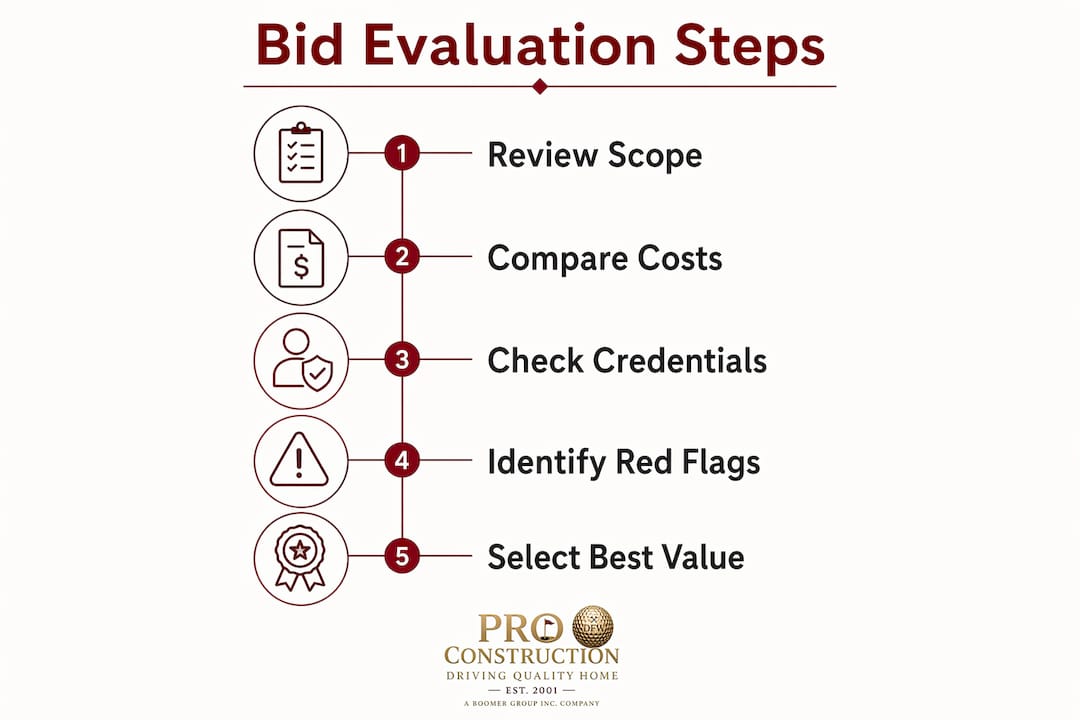
For a deeper breakdown of how to compare residential construction bids accurately, review the line-item methodology before you sit down with contractors.
What are the typical payment schedules and change order processes?
Payment structure is where many homeowner-contractor relationships break down. A fair payment schedule protects both parties and keeps the project moving without cash flow problems.
Payment schedules should be tied to verifiable milestones, not arbitrary dates. A common structure for a home addition might look like this:
| Milestone | Typical Payment Percentage |
|---|---|
| Contract signing | 10% |
| Foundation complete | 20% |
| Framing complete | 25% |
| Rough-in inspections passed | 20% |
| Drywall and finishes complete | 15% |
| Final walkthrough and punch list | 10% |
Retainage is money earned but withheld until substantial completion. Retainage typically runs 5%–10% of each payment, and some states require its release within 30–45 days of project completion. Retainage gives you leverage to get punch list items resolved before you hand over the final check.
Watch for these payment warning signs:
- A contractor who demands more than 10%–15% upfront before work begins
- Cash-only payment requirements with no paper trail
- Requests to pay subcontractors directly instead of through the GC
- No written payment schedule in the contract
Change orders are inevitable on most projects. A professional contractor handles them with a written document that describes the change, the cost impact, and the schedule impact before any work begins. Never allow verbal change orders. Every approved change should be signed by both parties and added to the contract file.
How do general contractors differ from construction managers?
The terms "general contractor" and "construction manager" are often used interchangeably, but they describe different roles with different levels of financial risk and responsibility.
Construction managers act as owners' representatives, focusing on oversight, scheduling, and budget monitoring. They do not typically hold trade contracts or carry direct financial risk for construction costs. A general contractor, by contrast, executes the work. They hire and pay subcontractors, pull permits, and are legally responsible for delivering the finished product.
Here is how the two roles break down in practice:
- General contractor: Holds subcontracts, manages crews, carries construction risk, and delivers a finished product at an agreed price.
- Construction manager: Advises the owner, monitors progress, and manages the budget on the owner's behalf. Often used on larger commercial projects.
- CM/GC and CMAR delivery methods: These hybrid approaches bring the contractor in during preconstruction. Early GC involvement in preconstruction reduces change orders and confirms constructability before the budget is locked.
For most homeowners managing a renovation or home addition, a licensed general contractor is the right choice. Construction management as a standalone service makes more sense for large commercial projects or owners who want to manage trade contracts themselves.
Pro Tip: If your project is complex, ask your GC whether they offer preconstruction services. Spending a few hours aligning scope and budget before breaking ground can eliminate weeks of delays later.
How should you communicate and oversee an active project?
Clear communication is not a soft skill in construction. It is a project management tool that prevents disputes, delays, and cost overruns.
Contractors who are slow to respond during bidding typically communicate worse once work begins. Test responsiveness before you sign. Send an email, leave a voicemail, and see how quickly and clearly they reply. That pattern holds throughout the project.
Once work starts, follow these practices:
- Document everything. Keep a project folder with the signed contract, all bids, change orders, payment receipts, and inspection reports. A written record resolves disputes faster than memory.
- Schedule weekly check-ins. A 15-minute call or site visit each week keeps you informed and gives the contractor a chance to flag issues before they become expensive.
- Ask for a subcontractor list. A good GC names their subcontractors and explains work sequencing clearly. Knowing who is doing the electrical, plumbing, and HVAC work lets you verify their licenses independently.
- Visit the site during active work. You do not need to hover, but a weekly walk-through lets you see material quality, workmanship, and whether the site is organized and safe.
- Get all approvals in writing. If you approve a material substitution or a schedule change verbally, follow up with an email confirming the decision. That email is your paper trail.
A well-defined written contract should include the scope of work, payment schedule, start and completion dates with penalties, change order process, warranty terms, and a dispute resolution clause. If your contract is missing any of these elements, ask for them before signing.
Key takeaways
Hiring the right general contractor comes down to verifying credentials, reading bids carefully, and maintaining a documented paper trail from the first meeting to the final walkthrough.
| Point | Details |
|---|---|
| Verify license and insurance first | Confirm an active state license, $1M general liability, and workers' comp before any other step. |
| Get three itemized bids | Compare line items across bids to spot missing scope and unrealistic allowances. |
| Tie payments to milestones | Use a milestone-based schedule with 5%–10% retainage held until substantial completion. |
| Document every change order | Require written, signed change orders before any out-of-scope work begins. |
| Test communication before hiring | A contractor's response speed during bidding predicts their behavior throughout the project. |
What 25 years in north texas taught me about hiring right
Most homeowners focus on price first. That instinct is understandable, but it is the wrong starting point. After 25 years building home additions and garages across North Texas, the projects that went sideways almost always started with a contractor who looked fine on paper but failed on the basics.
License and insurance checks are not optional steps you get to when you have time. They are the first filter. If a contractor cannot produce a current Certificate of Insurance within 24 hours of your request, stop the conversation. That hesitation tells you everything about how they will handle a problem mid-project.
The second thing I have learned is that scope clarity protects everyone. Homeowners who come to us with a detailed scope get better bids, fewer surprises, and faster timelines. Vague scopes invite vague bids, and vague bids lead to change orders that inflate the final cost by 15%–30%.
Visit a contractor's active job site before you decide. A clean, organized site with clearly staged materials and a crew that knows what they are doing is a stronger signal than any review on Houzz or Google. You can see professionalism. You cannot fake it.
Finally, ask the contractor to name every subcontractor they plan to use and describe the sequence of work. A GC who can walk you through demo, rough-in, inspections, and finishes in order is a GC who has done this before. One who gives you a vague answer about "getting the right people" is telling you they are figuring it out as they go.
— PRO
PRO construction handles the details so you do not have to
If you are planning a home addition, garage build, or renovation in North Texas, PRO Construction brings over 25 years of experience and a top 1% BuildZoom ranking to every project. Transparent bids, licensed subcontractors, and milestone-based payment schedules are standard, not optional extras.

PRO Construction specializes in home additions in Keller, TX and custom garage builds across the DFW area. Current discounts are available on select projects. Every client gets a dedicated project manager, a written scope before work begins, and regular updates throughout the build. Contact PRO Construction today to request a detailed, itemized quote and see why homeowners across North Texas trust us with their most important investments.
FAQ
What does a general contractor actually do?
A general contractor manages all aspects of a construction project, including hiring subcontractors, pulling permits, and coordinating schedules. They serve as the single point of accountability for budget, timeline, and finished quality.
How much should a general contractor charge upfront?
A fair upfront deposit is typically 10%–15% of the total contract value. Any contractor requesting more than that before work begins is a financial risk worth avoiding.
What is the difference between a licensed and unlicensed contractor?
A licensed contractor has met state competency and insurance requirements verified by an official licensing board. An unlicensed contractor carries no such verification, leaving you with no legal recourse if work is incomplete or defective.
How do i know if a bid is missing something?
Compare line items across at least three bids. If one bid is significantly lower, look for missing categories like permits, cleanup, or specific materials. Low allowances are another common way contractors reduce bid totals while planning to charge more later.
When should i withhold final payment?
Withhold the final payment, typically 5%–10% retainage, until the punch list is complete, all inspections are passed, and you have received lien waivers from the contractor and all subcontractors.