

A subcontractor is a licensed specialist hired by a general contractor to perform a specific trade within a larger construction project. Understanding the role of subcontractors explained in plain terms is what separates homeowners who manage projects confidently from those who get blindsided by delays, lien notices, and payment disputes. Your contract is with the general contractor (GC), not the subcontractors. That single fact shapes every communication, payment, and legal obligation on your project.
What is the role of subcontractors in construction?
A subcontractor delivers specialized trade work under the direction of a GC, not directly for you. The hiring chain runs from homeowner to GC to subcontractor. Day-to-day coordination and payment administration sit entirely with the GC. Electricians, plumbers, framers, HVAC technicians, and roofers are all classic examples of subcontractors on a residential build.
The GC manages the full project. Subcontractors execute their assigned slice of it. Prime contractors remain responsible for overall project quality and schedule, even when a subcontractor causes the problem. That distinction matters enormously when something goes wrong.

This structure exists because no single company can master every trade. A GC who tries to self-perform electrical, plumbing, and structural framing simultaneously will almost always deliver inferior results. Subcontracting concentrates expertise where it counts.
What are subcontractor responsibilities on a project?
Subcontractor responsibilities go well beyond just showing up and doing the work. They include schedule compliance, quality standards, safety documentation, and contractual paperwork. Most homeowners never see this layer of obligation, but it directly affects whether your project finishes on time.
The key duties subcontractors carry include:
- Trade execution: Complete their assigned scope to the quality standards written into the prime contract.
- Schedule adherence: Work within the GC's master schedule, since one delayed sub can push every trade behind them.
- Safety compliance: Maintain safety plans and approved documentation. Subcontractor compliance with insurance and safety requirements is integral to project approvals, not optional.
- Change order management: Submit and track change orders through the GC, not directly with you.
- Reporting: Communicate progress, issues, and delays to the GC, who then communicates with you.
Flow-down clauses are the contractual mechanism that makes this work. They incorporate the prime contract's scope, schedules, payment terms, and dispute resolution procedures directly into the subcontract. A subcontractor who signs a subcontract with flow-down language is bound by the same schedule and quality standards you negotiated with your GC.
Pro Tip: Ask your GC to confirm that all subcontracts include flow-down clauses tied to your prime contract. This single step closes the most common gap between what you expect and what subs are legally required to deliver.
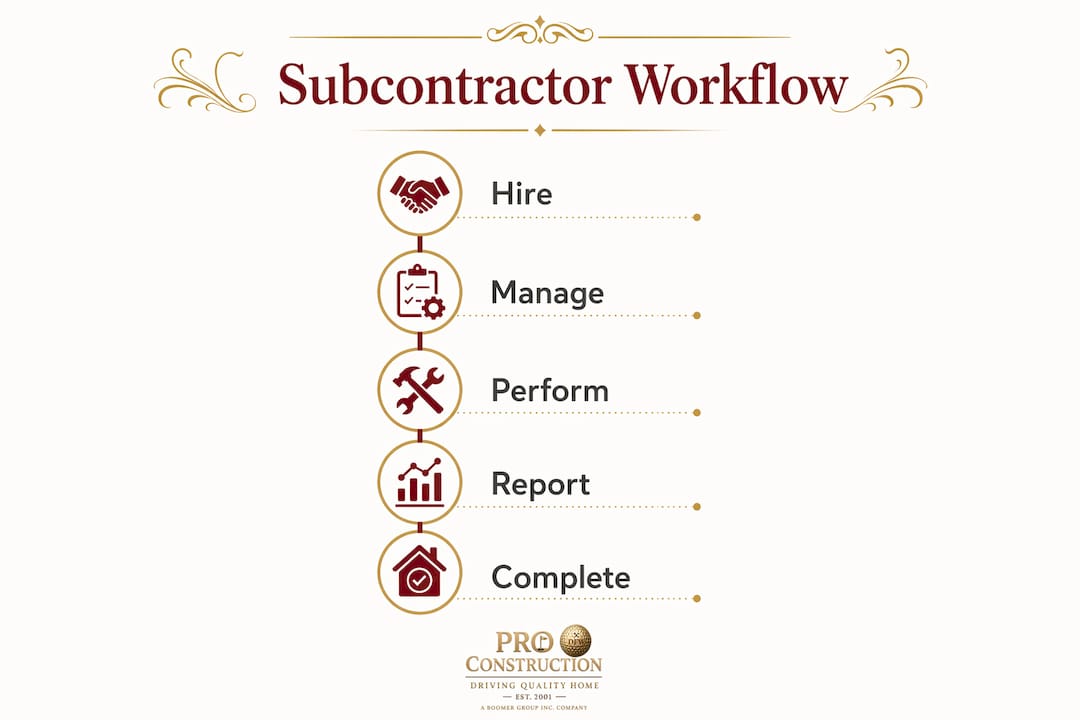
Poorly managed subcontractor documentation and notice timing can cause disputes that appear to you as unexplained delays or rework. The root cause is almost always a paperwork failure, not a skills failure.
Subcontractors vs. contractors vs. employees: what is the difference?
These three categories carry different legal relationships, payment structures, and liability chains. Homeowners who confuse them often make costly assumptions about who is responsible for what.
| Category | Who They Work For | How They Are Paid | Who Bears Liability |
|---|---|---|---|
| General Contractor | Directly for the homeowner | Paid by homeowner per contract | Responsible to homeowner for full project |
| Subcontractor | Hired by and reports to GC | Paid by GC, not homeowner | Liable to GC for their specific trade scope |
| Employee | Works under employer direction | W-2 wages from employer | Employer bears liability for their work |
Subcontractors rarely interact directly with homeowners, which is the source of most homeowner confusion about responsibility and liability. When a plumber on your job site makes eye contact and says "we'll have that done by Thursday," he is telling his GC's schedule, not making a promise to you. Your GC owns that commitment.
Contractors bear ultimate responsibility for project delivery. If a subcontractor's work fails, your legal recourse is with the GC. The GC then pursues the subcontractor internally. This is why contractor reputation matters so much. A GC who vets and manages subcontractors rigorously protects you from problems you would never see coming.
How do subcontractors affect your project as a homeowner?
General contractors serve as the single point of coordination for scheduling, supervising, and paying subcontractors. Your job is to work through that channel, not around it. Bypassing your GC to give instructions directly to a subcontractor creates conflicting directions and can void your contract protections.
Here is how to protect yourself through the GC relationship:
- Verify insurance certificates. Before work starts, ask your GC to provide certificates of insurance for every subcontractor on site. A sub without coverage puts your property at risk.
- Confirm written subcontracts exist. Verbal agreements between GCs and subs create payment disputes that delay your project. Written subcontracts with clear scope and schedule terms are non-negotiable.
- Track the payment schedule. Payment risks from pay-when-paid clauses and mismatched timing between owner-GC and GC-sub payment schedules are a leading cause of project disputes. Understand when your GC pays subs relative to when you pay your GC.
- Monitor permit and inspection milestones. Subcontractors trigger inspections at key stages. Electrical rough-in, plumbing rough-in, and framing inspections must pass before work can proceed. Ask your GC for a schedule of these milestones.
- Request lien waivers at each payment. Every time you pay your GC, request signed lien waivers from the major subcontractors. This confirms they have been paid and cannot file a lien against your property for that work.
Pro Tip: Keep a simple spreadsheet tracking each subcontractor's name, trade, insurance expiration date, and lien waiver status. Your GC should provide this information. If they resist, that resistance tells you something important about how they manage subs.
Understanding how subcontractors work through the GC also helps you read your construction contract more accurately. Review the construction contract basics before signing so you know exactly what your GC is obligated to manage on your behalf.
What are texas-specific rules for subcontractors and lien rights?
Texas construction law gives subcontractors specific legal protections that directly affect your property. Understanding these rules is not optional for Texas homeowners. A subcontractor who follows the right steps can place a lien on your home even if you paid your GC in full.
The key Texas requirements for subcontractors include:
- Preliminary notice deadline: Subcontractors must send preliminary notices to preserve mechanics' lien rights. For residential projects, this notice is due by the 15th day of the second month after the month in which work was performed.
- Notice recipients: The preliminary notice must be sent to both the property owner and the GC. Sending it only to the GC does not satisfy the requirement.
- Written contract requirement: Residential lien rights require a written contract executed before work or materials are furnished. If the property owner is married, both spouses must sign the contract.
- Lien filing deadline: After sending proper notices, a subcontractor must file a lien affidavit with the county clerk by the 15th day of the fourth month after the month in which work was last performed on a residential project.
| Requirement | Residential Deadline | Who Must Receive Notice |
|---|---|---|
| Preliminary notice | 15th day of 2nd month after work | Property owner and GC |
| Lien affidavit filing | 15th day of 4th month after last work | County clerk |
| Written contract | Before work begins | Both spouses if owner is married |
These rules exist to protect subcontractors from GCs who collect payment from homeowners but fail to pay their subs. The practical implication for you: a subcontractor who follows these steps correctly can enforce a lien even if your GC took your money and disappeared. Verifying that your GC pays subcontractors promptly is not just good project management. It is how you protect your property title. You can also verify contractor licenses in Texas before signing any contract to reduce this risk from the start.
Key takeaways
The most effective way to protect yourself on a construction project is to understand that your GC is legally responsible for subcontractor performance, payment, and documentation.
| Point | Details |
|---|---|
| Subcontractor hierarchy | Subcontractors report to and are paid by the GC, not the homeowner. |
| Flow-down obligations | Subcontracts should mirror prime contract terms for scope, schedule, and quality. |
| Texas lien deadlines | Residential preliminary notices are due by the 15th day of the second month after work. |
| Payment risk | Request lien waivers from major subs at every payment milestone to protect your title. |
| GC accountability | Your legal recourse for subcontractor failures runs through your GC, not directly to the sub. |
What 25 years of managing subcontractors has taught me
The biggest misconception homeowners carry onto a job site is that subcontractors answer to them. They do not. Subs answer to the GC who hired them, scheduled them, and will pay them. When homeowners try to redirect a sub directly, it creates two sets of instructions and one confused crew. The result is always extra cost and lost time.
The second thing I have seen consistently is that payment timing causes more project failures than bad craftsmanship. Pay-when-paid clauses mean a sub does not get paid until the GC gets paid. When homeowners delay payments to their GC, that delay cascades down to every subcontractor on the project. Subs who are not paid move to jobs where they will be. Your project stalls. The fix is simple: pay on schedule and require your GC to do the same.
Documentation is the third area where projects quietly fall apart. A subcontractor who misses a preliminary notice deadline in Texas loses lien rights. That sounds like it protects you, but it actually signals a disorganized sub who may also be cutting corners on the work itself. I always tell homeowners: a sub who manages paperwork well manages their trade well. The two habits travel together.
The homeowners who have the smoothest projects are not the ones who micromanage every sub. They are the ones who hire a GC they trust, review the contract carefully, and ask the right questions at the right times. That is the whole job.
— PRO
Work with a team that manages every sub for you
PRO Construction has spent over 25 years managing subcontractors on home additions and garage builds across North Texas, including Keller, Fort Worth, and Argyle. Every subcontractor on a PRO Construction project carries verified insurance, works under a written subcontract, and follows a documented payment schedule. You never have to chase a lien waiver or wonder if your plumber was paid.

PRO Construction holds a top 1% ranking on BuildZoom, which reflects the quality of every trade partner on every project. If you are planning a home addition or garage build and want a team that handles subcontractor coordination from day one, explore home addition services in Keller or contact PRO Construction directly to ask about current discounts and availability.
FAQ
What is a subcontractor in construction?
A subcontractor is a licensed specialist hired by a general contractor to perform a specific trade, such as electrical, plumbing, or framing. The subcontractor reports to and is paid by the GC, not the homeowner.
Can a subcontractor place a lien on my home in texas?
Yes. A subcontractor who sends timely preliminary notices and files a lien affidavit by the required deadlines can place a mechanics' lien on your property, even if you paid your GC in full.
Should i communicate directly with subcontractors on my project?
No. All instructions and questions should go through your GC. Direct communication with subs creates conflicting directions and can undermine your contract protections.
What are flow-down clauses in a subcontract?
Flow-down clauses extend the prime contract's scope, schedule, payment terms, and dispute resolution procedures into the subcontract. They align subcontractor duties with the obligations your GC owes you.
How do i protect myself from unpaid subcontractor liens?
Request signed lien waivers from major subcontractors at each payment milestone. This confirms they have been paid for completed work and cannot file a lien against your property for that portion of the project.